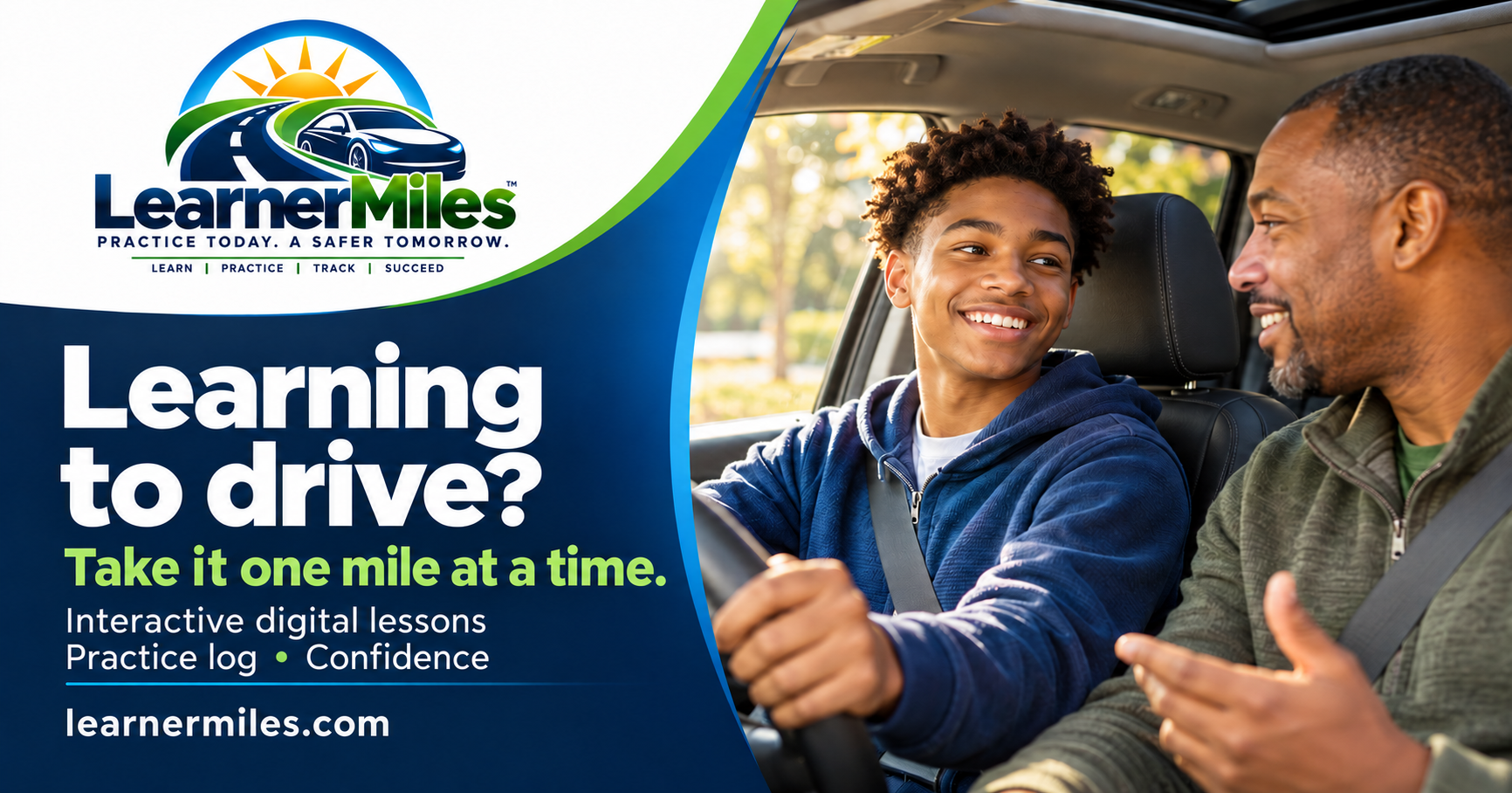
You’re in the right place. Turn your first parking-lot practice into a clear learning plan for you and your coach.
New to LearnerMiles?
Continue learning together
Your subscription includes:
10 skill levelsIllustrated, step-by-step driving lessons you can revisit at your own pace.
Detailed practice recordsSave observations, learner explanations and progress between sessions.
Sassi guidanceEncouragement and practical prompts for students, parents and coaches.
Readiness suggestionsSee what to practice next. Every skill level stays open.
$19every 30 days
Renews automatically until canceled. Cancel future renewals anytime; your access continues through the end of your current paid period. Payments are accepted securely through LearnerMiles.
Next: on the account screen, choose Sign Up if you’re new. Create your account, complete subscription payment, then open your workbook. Creating an account alone does not activate paid access.
Learn to drive together—one calm, focused practice at a time.
Teaching a teen to drive—or learning as an adult? Know what to practice, what your coach should say and what is improving with each drive.
Start free: Try a guided parking-lot lesson and unlock your practice record. No card required. Continue with the full digital workbook for $19 every 30 days if it fits your needs.
A 35-45 minute practice plan for an automatic vehicle. Follow the driver manual, permit rules and supervision requirements where you live.
01 | Prepare the place and meet the learner
Set up a controlled space
Choose a flat, quiet parking lot where practice is allowed. Work in daylight with a clear straight path, generous space from people and parked cars, and a visible start and stopping area. The coach sits in the front passenger seat. Confirm local permit, supervision, insurance and property rules before moving; a parking lot may still be subject to road rules.
Ask before teaching
What have you driven before? How do you feel from 0 to 10? What worries you about moving the car? Would a demonstration or a spoken explanation help first? Agree on a simple “pause” instruction: stop safely, secure the car and reset.
Mindset before movement
A nervous learner needs room to think. Ask them to describe what a calm, controlled first start would feel like. Watch the linked DriversEdu1 coach video while parked, then discuss one idea they want to try.
Watch and discuss while parked; put the phone away before movement.
02 | Walk around and identify the car
Pre-entry check
With the car secured, walk around it. Look under and behind it for people, animals, obstacles, broken glass and fresh leaks. Notice tire damage, lights, windows, mirrors, wipers, doors and seat belts. A walk-around does not certify roadworthiness. Stop and get qualified help if a safety-critical problem is suspected. Check registration, insurance, plates and equipment requirements in your own region before road use.
Identify the controls while parked
Have the learner show you the seat and head restraint adjustment, seat belt, mirrors, turn signals, hazard lights, headlights, wipers, parking brake, dashboard warnings and gear selector. Explain Park (P), Reverse (R), Neutral (N) and Drive (D) for this automatic vehicle. Point out the backup camera if present; it supplements, rather than replaces, looking around. Adjust the seat and mirrors, buckle everyone, remove anything near the pedals and keep the phone away.
Coach questions
What did you find on the walk-around? Which control would you use to signal a turn? Where will you look before selecting a gear? What concern would make us stop before practice?
03 | Rehearse right-foot pedal pressure
Find the pedals with the vehicle secured
For this automatic-vehicle lesson, the accelerator is on the right and the brake is to its left. Use the right foot for both; keep the left foot away. With the vehicle powered off, in Park and the parking brake applied, move the right foot from brake to accelerator and back without looking down. Do not press both pedals together. The brake may feel firmer with power off; the coach should explain the actual vehicle response before movement.
Practice pressure
Describe light, gradual pressure on the accelerator and a gradual increase in brake pressure to slow. Let the learner explain which pedal makes the car go and which slows it. Rehearse taking the foot off the accelerator and moving to the brake. If the learner uses two feet or cannot locate the brake, pause and repeat stationary practice. Electric vehicles may have regenerative or one-pedal settings; check the vehicle manual.
Scan or tap while parked; put the phone away before movement.
04 | Move, slow and stop at walking pace
Before selecting Drive
The coach demonstrates first if helpful. The learner identifies the clear travel path and stopping marker, places two hands on the steering wheel, holds the brake with the right foot and checks all around. Select Drive only when clear, releasing the parking brake as the vehicle requires.
First movement
Ease brake pressure gradually. If the car moves at idle creep, practice controlling that before adding accelerator pressure. If needed, use only a small, gradual accelerator input. Look ahead along the path rather than down at the pedals. Ask the learner afterward: Did it begin with idle creep, gradual acceleration, too much pressure, or not move? Did you feel in control?
Slow and stop
Release the accelerator early, move the right foot to the brake and build pressure smoothly. Stop before the generous marker, then hold the brake. If a hazard appears, use the braking force needed to stop safely. Record whether the stop was smooth, abrupt, early or too late, and what the learner was looking at.
Repeat, reflect, secure
Try up to three short straight passes while conditions remain suitable. After each, ask: What did you notice? When did you start slowing? What would you change next time? Finish fully stopped, shift into Park, apply the parking brake and power off as appropriate. The record below captures each pass separately.
Sassi Motivation
One calm start and one controlled stop count. Ask the question, practice the part that needs work, and let confidence grow one mile at a time.
Coach: give one clear instruction at a time. Praise the choice the learner made well, then name one thing to try next.
This educational companion supports local driver manuals and qualified supervision. Check the rules and vehicle instructions that apply where you practice.
A parent, guardian or adult coach can unlock the online practice record. No payment or card required. Registration unlocks the free practice record; the full workbook is a separate $19 subscription every 30 days.
Follow ten progressive driving lessons, from vehicle orientation and smooth control to lane changes, independent decisions and road-test readiness.
Parents & coaches
Parent-taught driving support
Use calm coaching prompts, pre-drive safety checks and a driving progress tracker to plan each supervised practice session without guesswork.
Local support
Professional lessons near you
Find participating driving schools by service area, language and lesson type. Schools handle their own prices, availability, payment and lesson confirmations.
Practice with a plan—not pressure. Start with free driving tips, choose the access level that fits your learner, and add written or live-text guidance only when you need it.
Your learning tools
See what each access level includes
This is an information-only preview. Member tools do not open from this page.
✓
Plan • practice • reflect
Practice Log
Record supervised drives and review your next steps in the LearnerMiles digital workbook.
Explore the LearnerMiles digital workbook
➜
Progressive lessons
Learning Path
Build skills in a safe order, from vehicle orientation through road-test readiness.
Explore the LearnerMiles digital workbook
◎
Quick visual references
Road Basics
Review signs, markings, vehicle position and the ideas you need to recognize.
Free public information
⌖
Rules where you drive
Local Rules
Use official licensing resources for your state, region or country.
Free public information
?
Park first, then connect
SASSI Guidance
Purchase written driving guidance by email, priority message or scheduled instructor text chat.
Separate paid service
▣
Teaching & safety tools
Resources & Storefront
Find guides, recommended practice equipment and safety essentials.
Optional products and resources
Information only: these cards preview learning tools. Visit the LearnerMiles digital workbook for current lessons, access and subscription details.
In the media · Founder spotlight
Driving experience behind LearnerMiles
LearnerMiles founder Sasheen Maple was previously featured with Drivers Edu on WJZ’s “Where’s Marty?” segment with Marty Bass.
The July 22, 2025 feature visits Drivers Edu to discuss learning to drive. Explore the experience behind our approach to helping new drivers and their coaches.
Short visual lessons for new drivers, parents and coaches. Watch first, discuss the goal, then practice only when parked or in a safe and legal supervised setting.
Safety first: Never watch or operate a phone while driving. Local laws and your licensed professional instructor always take priority over general video guidance.
Monthly learning & member access
Learn at your pace, one mile at a time
Start with free resources, then explore our own LearnerMiles digital workbook. Follow illustrated lessons, save detailed practice logs and receive Sassi guidance for both learner and coach. Existing LearnerMiles members can still access their earlier records below.
No purchase
Start free
Free First Drive Kit
Driving tips video library
Road basics and safety information
Explore the LearnerMiles learning path
$0Public resources do not require a purchaseGet the free kitInteractive digital learning
LearnerMiles Digital Workbook
10 skill levels with illustrated, step-by-step lessons
Detailed practice logs with saved progress
Sassi guidance for students and coaches
Readiness grades suggest next steps; every level stays open
$19 every 30 daysSign up, then open your digital workbook after payment. Payments are accepted securely through LearnerMiles. Renews automatically until canceled. Access continues through the end of the current paid period.Enroll in the digital workbookReturning student sign-in
Already purchased a LearnerMiles plan? Your previous member access and saved records are still available through Existing Member Login.
Books, downloads & equipment
Resources & Storefront
The Mindset Behind the Wheel eBook
Printable driving checklists and lesson planners
Parent and coach toolkit
Instructor-selected practice equipment
Shop resourcesSecure checkout for LearnerMiles digital productsOpen Resources & StorefrontProfessional written support
SASSI Guidance
Email response from $9.99
Priority written response from $19.99
Scheduled 30- or 60-minute instructor text sessions
Secure LearnerMiles payment for every service level
If you previously bought a LearnerMiles plan, use the email from that checkout to sign in and access your existing dashboard. For the current digital workbook, use the returning student sign-in below. Your earlier LearnerMiles member access remains available here.
New student? Review our digital workbook membership for lessons, practice logs and Sassi learner-and-coach guidance. Enroll securely through LearnerMiles, then sign in to your workbook.
Smooth starts and stops, steering, scanning, reference points, reversing and basic parking.
03
Low-demand roads
Lane position, turns, signs, speed choice, following space and simple intersections.
04
Mixed conditions
Traffic, hills, multilane roads, merging, navigation, darkness and light weather.
05
Independent readiness
Route planning, hazard response, test routines and honest readiness checks.
Universal rule: move up only when the learner can repeat the current skill calmly and safely. Required hours are a legal minimum—not proof of readiness.
Ten-lesson starter plan
Exactly what to practice—and how to do it
Use these sessions in order, repeating any lesson until the learner can complete it calmly and consistently. The supervising driver should demonstrate when helpful, give one instruction at a time, and choose a legal practice area appropriate for the learner. These are general techniques; local law and professional instruction always control.
1Know the goal
Each lesson now identifies one measurable performance objective before practice begins.
2Match the environment
Use the lowest-demand legal setting that safely supports the skill being practiced.
3Coach what is observable
Record prompts, interventions and demonstrated actions—not labels or guesses.
4Confirm, then advance
One successful attempt is not mastery. Look for calm, repeatable performance across sessions.
01Orientation and vehicle setupControls • mirrors • safe start and shutdown
Steps
With the vehicle secured and engine off, walk around it. Look for people, objects, leaks, tire damage and the safest direction to move.
Sit upright with hips back, adjust the seat so every pedal can be fully operated without stretching, and set the head restraint appropriately.
Fasten seat belts. Adjust the interior and exterior mirrors only after the seat is set. Identify areas the mirrors do not show.
Locate the brake, accelerator, parking brake, gear selector, signals, hazard lights, lights, wipers, defogger and horn without looking for long periods.
Press and hold the brake, confirm the transmission is in Park or Neutral as required, then start the vehicle using its manufacturer procedure.
Practice the shutdown sequence: complete stop, hold brake, select Park or the locally required gear, apply parking brake, switch off, check surroundings, then exit safely.
Ready to advance: The learner completes the routine in the correct order without rushing and can identify every essential control.
Stop: Any warning light, unsafe seating position, faulty control or unexplained vehicle condition.
02Smooth starts, stops and steeringLow-speed control • braking • path of travel
Steps
Choose a large, legal, empty practice area in daylight. Agree on a straight path and stopping point.
Complete the setup routine. Hold the brake, select the correct driving gear, release the parking brake as required, check all around and signal if needed.
Ease pressure from the brake. Allow the vehicle to move slowly before adding gentle accelerator pressure.
Look toward the intended path—not down at the hood. Use small, smooth steering movements and let the wheel return under controlled hands.
To stop, look ahead, release the accelerator early and apply steady brake pressure. Ease slightly near the final stop to reduce the lurch.
Repeat at low speed until starting, traveling straight and stopping are smooth. Then practice wide left and right curves around visible reference points.
Ready to advance: Five smooth starts and controlled stops with stable lane/path position and no pedal confusion.
Stop: Pedal confusion, rapid acceleration, loss of path control or repeated coach intervention.
03Reversing and observationStraight reverse • slow control • reference points
Steps
Check the entire area before entering the vehicle. Remove hazards and choose a long, clear path with a fixed stopping point.
Hold the brake, select Reverse and perform the observation method required locally, including mirrors and the relevant blind area.
Release the brake gradually. Reverse at walking speed or slower; avoid accelerator input unless truly needed.
Look mainly in the direction of travel while making brief mirror checks. Keep both hands able to control the wheel.
Use tiny steering corrections. Remember that the rear of the vehicle moves toward the direction the steering wheel is turned.
Stop fully if the view is blocked, the learner becomes unsure, or any person or vehicle enters the practice area.
Ready to advance: The learner reverses slowly along a clear path, maintains observation and stops accurately without abrupt correction.
04Turns and simple intersectionsPosition • signals • observations • speed
Steps
Begin on a familiar low-speed route with light traffic. Review local right-of-way and turning-position rules first.
Before the turn, check mirrors, identify signs, signals, people and conflicting traffic, then signal at the distance required locally.
Move into the lawful position for the turn. Reduce speed before steering; do not enter too fast and brake sharply during the turn.
Look through the turn toward the lane or path the vehicle must enter. Check the relevant blind area for cyclists, motorcycles or pedestrians.
Turn smoothly without cutting the corner or drifting wide. Enter the correct lawful lane.
Let the steering return under control, cancel the signal if necessary, check the new traffic picture and adjust speed smoothly.
Ready to advance: The learner completes repeated left and right turns with timely signals, safe speed and correct final position.
On a familiar low-demand road, have the learner name the posted limit, current conditions and a safe speed choice.
Choose a fixed roadside point. When the vehicle ahead passes it, count the locally recommended minimum following interval; add more time in poor conditions.
Scan well ahead, then near, to both sides and through the mirrors. Avoid staring at one vehicle or the lane line.
Use commentary driving: name developing hazards such as brake lights, hidden driveways, parked cars, children, animals, cyclists or narrowing space.
When a hazard appears, first ease off the accelerator, increase space and identify an escape option. Brake or change position only when lawful and necessary.
Repeat until the learner recognizes hazards early instead of reacting at the last second.
Ready to advance: The learner maintains safe space, adjusts speed for conditions and identifies important hazards without constant prompting.
06ParkingPull-in • reverse • parallel method used locally
Steps
Choose a legal, quiet area and begin with spaces well away from other vehicles. Confirm which parking maneuvers are required locally.
Approach slowly, signal when required and position the vehicle with enough room to turn without crossing unsafe boundaries.
Check mirrors, blind areas and all sides for people or moving vehicles. Yield and stop whenever the path is not clear.
Turn toward the space at walking speed, looking where the vehicle must finish. Use reference points only as guides because vehicles differ.
Straighten the wheels as the vehicle aligns. Stop fully inside the space without contacting lines, curb or objects.
Secure the vehicle. Before exiting, check traffic and cyclists. Practice leaving the space with a complete all-around observation.
For parallel parking: Learn the locally taught method from an authorized instructor; practice initially with cones or generous empty spaces because reference points and test standards vary.
Ready to advance: The learner parks and exits slowly with continuous observation and safe final placement.
07Lane changes and mergingGap choice • communication • speed matching
Steps
Practice only after the learner holds speed and lane position reliably. Begin on a familiar multilane road with moderate or lighter traffic.
Check the interior and relevant exterior mirror. Identify vehicles already beside or approaching the intended space.
Signal as required. Check the relevant blind area using the locally taught method while keeping the vehicle steady.
Choose a gap that does not require another driver to brake or swerve. Maintain or adjust speed smoothly—do not drift while deciding.
Move gradually into the center of the new lane. Cancel the signal and restore safe following space.
For merging, use the acceleration lane when available to observe traffic, select a gap and match traffic speed within legal and safe limits. Yield according to local rules.
Ready to advance: The learner completes multiple lane changes with full observation, a clear signal, a suitable gap and stable control.
Stop: The learner turns the wheel while checking the blind area, freezes without maintaining the lane, or repeatedly chooses unsafe gaps.
Attempt this only after strong daylight control and only in conditions the coach can manage safely. Do not use severe weather as a lesson.
Before moving, clean windows and lights, activate the correct lights and visibility controls, and review local lighting and weather rules.
Reduce speed enough to stop within the clearly visible distance. Increase following space and avoid abrupt steering, braking or acceleration.
Scan for glare, reflections, standing water, slippery areas and people who may be difficult to see. Avoid looking directly at bright oncoming lights.
Use wipers, defogger and ventilation before visibility becomes poor. If visibility or grip becomes uncertain, leave the road safely.
End early if fatigue, fear or weather demand rises. Record the exact condition practiced rather than simply marking “night” or “rain.”
Ready to advance: The learner changes speed and spacing before conditions force a sudden response.
10Readiness reviewFull routine • representative route • honest gap list
Steps
Choose a lawful route that combines previously mastered skills without deliberately creating dangerous surprises.
Have the learner complete the vehicle check, route plan, start and exit routine independently.
Observe control, scanning, communication, speed, space, intersections, parking and recovery from a missed direction.
Give only safety-critical or necessary route instructions. Mark each skill as full coaching, frequent prompts, a few prompts or independently repeatable.
Repeat any weak maneuver in a lower-demand setting. Do not “practice until lucky” or advance because required hours are complete.
Compare performance with the official local road-test requirements and schedule professional review when needed.
Road-ready evidence: Safe choices are consistent across several sessions and conditions—not demonstrated once by chance.
Not ready yet: Pedal confusion, missed observations, unsafe gaps, repeated speed problems, coach intervention or inability to recover calmly.
The calm-car agreement
Safety before pride
Use this before the first practice and revisit it whenever tension rises.
Before the vehicle moves
Complete the pre-entry checks
Use this check every time. The learner and coach should agree that the vehicle, surrounding area and first movement are safe before beginning the practice entry.
1
Outside safety scan
Walk completely around the vehicle. Look for children, pedestrians, cyclists, pets, debris, low objects, damage, tire concerns and anything underneath.
2
Seat, belts and mirrors
Set the seat and head restraint first, fasten every seat belt, then adjust mirrors and identify the areas the mirrors do not show.
3
Controls and warnings
Locate the brake, accelerator, signals, lights, wipers, parking brake and gear selector. Resolve any warning or unsafe vehicle condition before moving.
4
Path and first movement
Confirm the intended path is clear, choose the safest first movement, check all around again and signal when required.
5
Practice goal and calm check
Name one or two skills for this session. Do not begin if the learner or coach is impaired, exhausted, angry, rushed or unable to focus safely.
Driving Lesson Progress Record
Record the whole lesson—not just minutes
Before driving
The learner and coach complete the safety check together and choose one clear lesson goal.
After driving
Record what was practiced, what improved and what needs more practice after the vehicle is safely parked.
Move forward when ready
No automatic score decides readiness. Advance only when the learner and coach agree the skill is safe, calm and consistent.
0 minutes logged
Sassi Guidance · Optional paid review
A clearer plan for your next practice.
Share one completed practice record with a professional instructor. Receive strengths, skills to repeat, questions to clarify and suggested next steps.
1. Share your record2. Pay securely3. Track your Sassi ticket4. Read instructor-approved feedback
After paying, return here and click “I completed payment.” Your instructor verifies the transaction before beginning the review. No payment is taken by submitting this form.
Save your ticket number. Use this browser to check replies, or sign in to the ticket tracker with the same email from another device.
Professional instructor review
Turn the practice record into a clear plan of action.
Send one completed LearnerMiles entry to a professional instructor for a written assessment and next-step recommendations.
1Complete the driving log
The instructor receives the lesson, safety answers, readiness decision and written observations.
2Instructor reviews performance
You receive strengths, concerns and a professional action plan.
3Add one personalized lesson
Choose an optional route, schedule and step-by-step lesson built around current performance.
✓
Request received
Your request has entered the instructor-review flow.
You do not need to prove anything in one lesson. You need to return home safely with one more skill than you had before.
How to improve focus
Sleep first. Eat something light. Silence the phone. Name today’s one main skill. Narrate what you see: road, signs, people, space, options.
When to begin
Start in full daylight during an off-peak hour in a legal, open area with very little traffic. Avoid school arrival, commute periods, shopping rushes and closing times. Confirm that practice is permitted there.
When anxiety rises
Exhale longer than you inhale, loosen your grip and say what you see. If focus does not return, pull over safely and finish for the day. Ending early is good judgment.
How coaches should correct
Say what to do, not only what went wrong: “ease off the accelerator,” “look left-right-left,” or “hold your lane.” Debrief after the vehicle is secure.
Global driving basics
Common signs and road markings
These pictures teach widely recognized road concepts—not one country’s complete sign system. Shapes, colors, words, driving side and legal duties can differ. Learn the general meaning here, then follow the official highway code or licensing authority where you drive.
Common sign concepts
Stop
Meaning: A complete stop is required.
Action: Stop at the designated point, observe and proceed only when lawful and safe.
Give way / Yield
Meaning: Give priority as local rules require.
Action: Slow, observe and stop if necessary before entering.
No entry
Meaning: Do not enter from this direction.
Action: Choose another lawful route; never continue against the restriction.
Speed limit
Meaning: The displayed maximum applies under local law.
Action: Do not exceed it; choose a lower safe speed when conditions require.
Traffic signals
Meaning: Lights control movement through a conflict point.
Action: Obey the illuminated signal and local turning rules; still check for hazards.
Pedestrian crossing
Meaning: People may cross at or near this point.
Action: Reduce risk, scan both sides and yield or stop as local law requires.
One way
Meaning: Traffic travels only in the indicated direction.
Action: Enter and travel only in the permitted direction.
Roundabout
Meaning: A circular intersection is ahead or mandatory.
Action: Slow, use the correct direction and give priority according to local rules.
Road work
Meaning: Workers, equipment or a changed road layout may be ahead.
Action: Slow down, increase space and obey temporary controls.
Railway crossing
Meaning: Rail tracks cross or approach the road.
Action: Look, listen and obey gates, lights and local stopping duties. Never stop on tracks.
No turn
Meaning: The pictured turning movement is prohibited.
Action: Continue lawfully and select another route.
General warning
Meaning: A hazard or special condition needs attention.
Action: Slow as needed, search for the specific hazard and prepare to respond.
Common road markings
Broken lane line
Meaning: Separates lanes; crossing may be permitted.
Action: Cross only when local rules allow and the move is fully clear.
Solid lane line
Meaning: Crossing is restricted, discouraged or prohibited.
Action: Stay in lane unless local rules clearly permit crossing.
Double solid center
Meaning: Opposing traffic is separated and crossing is generally prohibited.
Action: Remain on your side unless a specific local exception applies.
Edge line
Meaning: Shows the usable road edge or separates a shoulder.
Action: Keep the vehicle inside the travel area unless a lawful maneuver requires otherwise.
Stop line
Meaning: Marks where a vehicle must stop when required.
Action: Stop before the line without blocking crossings or junctions.
Yield line
Meaning: Marks the point for giving priority, often using triangles.
Action: Approach slowly and stop before it when necessary.
Crosswalk / crossing
Meaning: Designated area for people to cross.
Action: Keep it clear and yield or stop according to local law.
Directional arrows
Meaning: Show permitted or required lane movements.
Action: Choose the correct lane early and follow its lawful direction.
Remember: Familiar-looking does not mean identical. Words, symbols, colors and priority rules may change across borders. Before driving, study the current official road code for that location.
United States · all 50 states & D.C.
Who can supervise or teach?
Choose your state for a parent and coach checklist, approved parent-taught course questions, or professional instructor and school licensing resources.
Search for the official driver-licensing or transport authority for your state, province, territory or country. Record the answer and the official link.
What is the minimum learner age?
Is a permit or theory test required first?
Who may legally supervise?
How many supervised hours are required?
Are night hours required?
Is professional instruction mandatory?
What insurance must cover the learner?
Which documents and fees are required?
Are there passenger, phone or curfew restrictions?
What vehicle is allowed for the road test?
Which maneuvers are tested?
Does an official log or supervisor signature have to be submitted?
Paid professional support
SASSI Guidance: choose your written support
Ask a driving question and receive a written response through text, email or scheduled instructor text sessions. Written support keeps the instructions clear and makes translation easier when needed.
Text messageEmail responseScheduled instructor text chat
English-language support: Guidance is written in English. Because every response is delivered in writing, customers may use their preferred translation tool to read or reply in another language.
Park first, then connect. Text, email and live chat support may be used only before driving, after driving or while the vehicle is safely and legally parked. It is not emergency assistance, active supervision, legal advice or a replacement for an authorized in-car instructor. Never read, write or use live chat while operating a vehicle.
✓
Finish your request
Complete payment, then confirm your ticket.
Your ticket details are saved securely. Complete the LearnerMiles payment in the tab that opened, then return here.
Enter your email address or ticket number to find a SASSI Guidance request in your secure inbox. Use the original browser or sign in with the same email.
Paid—New
SG-000000
Due soon
Service
Delivery
Due by
Submitted
Your question
Payment submittedThe customer confirmed completion of secure LearnerMiles checkout.
Guidance review queuedThe question is ready for written review and an appropriate response.
Delivered or escalatedRoutine guidance is delivered quickly; safety-sensitive questions go to a professional instructor.
Park first, then connect. Do not read or reply while operating a vehicle. For an emergency, stop safely and contact local emergency services.
LearnerMiles Resources & Storefront
Helpful tools for safer, calmer practice.
Instructor-selected equipment for the vehicle, the practice area and the parent or coach teaching from the passenger seat.
Free state requirements guide
Before you teach, check who can supervise.
Official agency links and separate checklists for parents, coaches, professional instructors and driving schools.
The updated 160-page workbook with realistic vehicle graphics, step-by-step practice, coach prompts and Sassi motivation. Download for offline use or printing.
$29.99 once
Interactive membership and saved online progress are available separately.
Passenger-side brakes and permanent vehicle modifications should only be selected and installed by qualified professionals.
Ask a professional before purchasing
LearnerMiles originals
Digital coaching resources
Secure LearnerMiles checkout
Printable PDF
Driving Readiness Checklist Pack
Pre-entry, vehicle setup, practice-area and post-drive reflection checklists.
$7.99Secure payment and automatic digital deliveryBuy & downloadPrintable PDF
Progressive Lesson Planner
A structured planner covering ten lessons from vehicle orientation through independent readiness.
$12.99Secure payment and automatic digital deliveryBuy & downloadComplete toolkit
Parent & Coach Toolkit
Planning sheets, coaching prompts, grading guidance, lesson records and readiness tools.
$19.99Secure payment and automatic digital deliveryBuy & download
Affiliate disclosure: LearnerMiles may earn a commission from qualifying purchases made through recommended product links, at no additional cost to you. Product availability, pricing and suitability are controlled by the retailer. Always confirm that equipment is appropriate and legal where you drive.
School partners
Local expertise. A clearer next step.
Schools join through an upfront membership. Students book and pay the school directly for driving lessons.
Live instructor consultations will launch first. Our later marketplace will help learners find screened, locally eligible driving coaches. Before launch, it will include identity checks, credential and insurance verification, background screening where lawful, coach standards, safeguarding, incident reporting and clear cancellation rules.
Meet the school behind LearnerMiles
Connect with Drivers Edu Driving School for driving tips, community updates and school information.
Reviews on Google describe Drivers Edu Driving School experiences.