Table of Contents
- Private Driving Lessons vs. Parent-Taught Instruction: Key Differences
- Cost, Affordability, and Flexibility
- How to Teach a Teenager to Drive: The Parent's Role
- Safety, Skill Development, and Confidence Building
- Creating a Parent and Teen Driving Practice Plan
- Using a Teen Driving Practice Checklist to Stay on Track
- A Hybrid Approach: Combining Private Lessons and Parent Supervision
- Conclusion
- Frequently Asked Questions
Last Updated: October 18, 2026
Private Driving Lessons vs. Parent-Taught Instruction: Key Differences
The choice in private lessons vs parent taught driving shapes not just a teenager's skills but your relationship during a critical learning phase. Both paths work differently, and the right choice depends on your family's dynamics, your confidence as a teacher, and what your teenager needs most.
Private lessons offer professional structure and emotional distance. A paid instructor brings no family baggage into the car, follows a proven curriculum, and can stay calm when a learner makes mistakes. Parent-taught driving, by contrast, happens in a familiar vehicle with someone who knows your teenager's personality and fears. It's cheaper, more flexible, and builds a shared sense of accomplishment, but it also requires patience you might not have on day one.
The tension isn't about which option is "better." It's about understanding what each does well, where each struggles, and whether combining them solves problems neither can address alone. Below, we'll walk through the real differences, the trade-offs, and a practical framework for choosing, or blending, both approaches.
Cost, Affordability, and Flexibility
Private driving lessons come with a clear financial commitment. Pricing depends on the instructor's experience, location, and the number of lessons purchased. Package deals sometimes offer discounts, but the total investment can still be substantial for a basic course.
Parent-taught driving has almost no direct cost. You're using a vehicle you already own, fuel you'd be buying anyway, and your own time. The only real expense might be workbooks or structured practice guides.
That cost difference matters, especially for families managing tight budgets. But affordability isn't just about sticker price. Private lessons require booking appointments and traveling to a lesson location. Parent-taught practice can happen on your own schedule: a quiet street on Saturday morning, a highway drive on a weeknight, whenever you're both ready.
For working parents juggling school pickups and evening commitments, that flexibility is invaluable. But it cuts both ways: with no external deadline pushing you to practice consistently, some families find themselves three months in, realizing they've only practiced twice.
| Aspect | Private Lessons | Parent-Taught |
|---|---|---|
| Cost per session | $50-$100+ | Minimal (fuel only) |
| Total course investment | $500-$1,200+ | $0-$200 (optional guides) |
| Scheduling | Fixed appointments | Your own schedule |
| Consistency | Built-in structure | Self-directed |
| Best for | Busy families needing structure | Budget-conscious, flexible families |
How to Teach a Teenager to Drive: The Parent's Role
Teaching your teenager to drive as a parent means being part driving coach, part emotional anchor, and part referee.
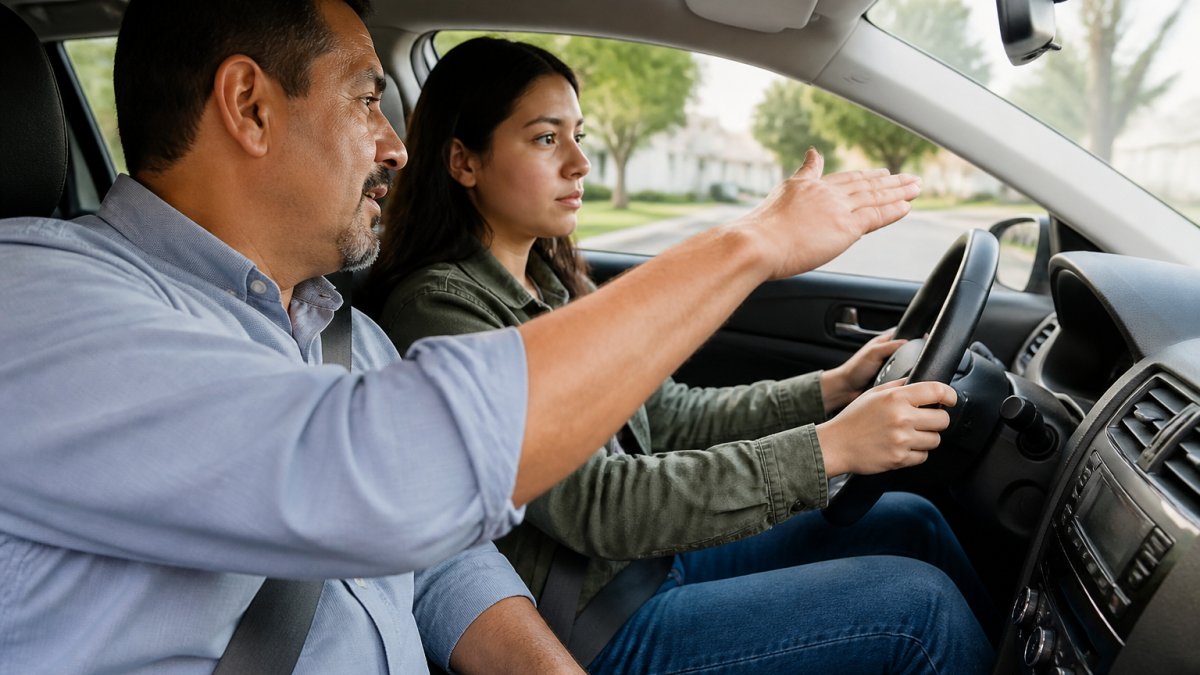
Start with a clear agreement about what you both expect. Before the first practice session, talk about what "good practice" looks like: Will you give feedback constantly, or only when something feels unsafe?
Your role as a parent is fundamentally different from an instructor's. An instructor is a stranger, so your teenager can take feedback without feeling judged as a person. When you're the teacher, criticism can feel personal.
Consistency matters more than perfection. Your teenager needs regular, low-pressure practice in gradually more complex situations: empty parking lots, then quiet residential streets, then busier roads, then highway driving. Each step builds on the last, and confidence grows when they see themselves handling new challenges.
The hardest part of parent-taught driving isn't teaching, it's managing your own anxiety. If you're nervous, your teenager will feel it. Your job is to stay calm even when they do something that makes your heart race.
Safety, Skill Development, and Confidence Building
Safety is where the two approaches differ most clearly. Professional instructors have insurance, dual-control pedals, and years of experience managing nervous learners in unpredictable situations. They've seen hundreds of mistakes and know how to correct them without escalating tension.
Parent-taught driving puts safety in your hands. You don't have a backup brake pedal, so if your teenager freezes or makes a dangerous move, you react verbally and hope they respond in time.
Skill development follows a different timeline with each approach. Professional instructors follow a structured progression: basic vehicle control, then intersection navigation, then highway driving. Each lesson builds on the last, with no guesswork about what to practice next.
Parent-taught practice is less structured, which can be an advantage or a disadvantage. The advantage: you can focus on what your teenager struggles with most. If merging on highways terrifies them, you practice merging until it doesn't.
Confidence building is where the two paths diverge most. Private lessons build confidence through professional validation: an instructor says "You did that well," and your teenager believes it because the instructor is an expert. Parent-taught practice builds confidence through repetition and shared experience.
But confidence built through parent-taught practice is fragile if it's not backed up by real skill.
Creating a Parent and Teen Driving Practice Plan
A practice plan is simply a map of what you'll work on and when. Without one, sessions become reactive: you drive around until something feels wrong, or practice whatever your teenager feels like that day. With a plan, you're intentional.
Start by identifying the skills your teenager needs to master. These typically include: basic vehicle control (steering, braking, acceleration), turning at intersections, merging onto highways, parking (including parallel parking), driving in different weather or lighting conditions, and responding to unexpected situations.
Next, sequence those skills from easiest to hardest: empty parking lot, quiet residential streets, busier streets, then highway driving. This progression builds confidence gradually, so your teenager isn't handling three new challenges at once.
Try the Free First Drive Kit →
Set a realistic practice schedule. Most learners benefit from consistent practice, two or three sessions per week is better than one long session per month. Each session might be 30 to 60 minutes. Longer than that, and fatigue sets in. Shorter than that, and you don't have time to work through real challenges.
Document what you practice. Keep a simple log: date, what you worked on, what went well, what needs more practice. It shows progress and tells you where to focus next. If the log shows you've practiced highway merging twice in three months, that's your signal to prioritize it.
Using a Teen Driving Practice Checklist to Stay on Track
A checklist transforms a vague idea of "practice" into concrete actions. It answers the question: What exactly should we work on today? And it gives your teenager a sense of progress as they check things off.
A basic teen driving practice checklist might include:
- Vehicle inspection: tires, mirrors, lights, wipers, fuel level
- Adjusting seat, mirrors, and steering wheel for comfort and visibility
- Starting the engine and understanding dashboard controls
- Smooth acceleration and braking in an empty lot
- Turning left and right at low speed
- Stopping at stop signs and traffic lights
- Navigating a simple intersection with traffic
- Merging onto a multi-lane road
- Changing lanes safely on a highway
- Parallel parking
- Driving in rain or reduced visibility
- Responding to unexpected obstacles or pedestrians
- Highway driving at posted speed limits
Don't try to master everything in one week. Spread these skills across several weeks or months, depending on how often you practice. The checklist isn't a test, it's a roadmap. Your teenager doesn't need perfection at each skill before moving on, just enough competence that the new skill doesn't feel overwhelming.
Checklists also reduce arguments about progress. Instead of "You're not ready to drive on the highway yet," you can point to the checklist: "We've checked off these five skills. The next one is merging, so let's work on that this week." It keeps the focus on the task, not on judgment.
A Hybrid Approach: Combining Private Lessons and Parent Supervision
Many families find that the best path combines both approaches in private lessons vs parent taught driving: a few private lessons to establish fundamentals and give your teenager professional feedback, plus consistent parent-supervised practice to build real-world experience and confidence.
Here's how a hybrid approach typically works. Your teenager takes a few private lessons early on, enough to learn basic vehicle control and understand what good technique looks like.
Meanwhile, you're also practicing with them, working on the same skills in your own vehicle and on your own schedule. A structured practice framework can help you know what to focus on between lessons, LearnerMiles guided practice membership provides a progression of behind-the-wheel lessons and a digital practice log.
After the initial lessons, you might take a break from professional instruction and focus on parent-supervised practice for a few weeks, building real experience in highway driving, different weather, and busier traffic. You're the coach, and they're the driver.
Then, a few weeks before the road test, your teenager might take another round of private lessons, maybe two or three, to get professional feedback on how close they are to test-ready.
This hybrid approach can be a cost-effective option compared to full professional instruction. It gives your teenager the benefits of both: professional structure and feedback, plus the real-world experience and family support that comes from parent-supervised practice.
The hybrid approach also takes pressure off your relationship. You're not the only person your teenager is learning from, so the instructor provides an outlet that doesn't involve family dynamics.
Conclusion
The choice between private lessons and parent-taught driving isn't really either-or. Private lessons give your teenager professional feedback and structure. Parent-taught practice gives them real-world experience, flexibility, and confidence from practicing with someone who knows them.
Many families find that combining both works best, a few professional lessons to establish fundamentals, regular parent-supervised practice to build experience, and maybe another lesson or two before the road test. That approach balances cost, flexibility, and learning outcomes.
Whatever path you choose, learning to drive is about more than passing a test. It's about building the skills and confidence your teenager needs for the rest of their lives. Explore LearnerMiles guided practice membership to see how a structured approach can reduce guesswork and build confidence during this critical learning phase.
Frequently Asked Questions
Are private driving lessons better than learning to drive with a parent?
Neither is universally better, it depends on your teen's needs, your comfort level, and your schedule. Private lessons offer professional instruction and a neutral learning environment, while parent-taught driving provides familiarity, affordability, and continuity. Many families find a combination of both works best. A professional instructor can teach core skills and road test preparation, while parent-supervised practice builds confidence in everyday driving situations.
Can a parent teach a teen to drive without professional lessons?
Yes, parents can teach their teens to drive through supervised practice, though legal requirements vary by jurisdiction. Check your local licensing authority for minimum practice hours and any mandated classroom instruction. Parent-taught driving works best when parents understand traffic laws, model safe habits, and use a structured approach with clear expectations. Tools like a practice checklist and a communication agreement can help organize sessions and reduce stress between parent and teen.
How do I choose between private lessons and parent-supervised practice?
Consider your teen's confidence level, your teaching experience, your schedule, and your budget. If your teen feels anxious or defensive with you, a professional instructor may reduce conflict and build skills faster. If cost is the main concern and you're a calm, patient driver, parent-supervised practice is viable, especially with structured guidance. Many families benefit from a hybrid plan: professional lessons for foundational skills and road test prep, parent practice for everyday scenarios and confidence building.
What should a parent and teen driving practice plan include?
A solid practice plan covers progressive skill levels, from quiet streets to busier roads; specific lesson goals for each session; a communication agreement that sets expectations and reduces conflict; pre-drive checks for vehicle safety; and a progress log to track what's been practiced. A practice checklist helps ensure you're covering essential skills like lane changes, parking, and highway merging. Regular feedback and readiness reflection help your teen understand their progress and build confidence.