
Quick Summary
An occupational therapy driving evaluation is a structured assessment, run by a licensed occupational therapist, that checks whether a person can drive safely. It usually combines a clinical assessment of vision, thinking, and physical skills with an optional on-road drive. Results can support a clearer decision than a family observation alone.
- The evaluation usually has two parts: a clinical assessment and an optional on-road drive with a certified specialist.
- Referral rules differ, so some programs need a physician order while others accept self-referrals.
- Bring a current medication list, glasses or hearing aids, your license, and any required referral or records.
- Results may be full clearance, conditional driving, stopping driving, or inconclusive, and each has a next step.
- An evaluation is a snapshot of one day, so treat its results as one input among many.
Table of Contents
- What an Occupational Therapy Driving Evaluation Is
- Who May Benefit and How a Referral Works
- What Happens During the Clinical Assessment
- Off-Road Driving Assessment Versus On-Road Driving Evaluation
- Preparing for Your Senior Driving Evaluation Near Me
- Costs, Insurance Coverage, and What Results Can Mean
- Booking Your Evaluation and Planning Next Steps
- Frequently Asked Questions
Occupational Therapy Driving Evaluation for Seniors Explained
Last Updated: November 7, 2026
What an Occupational Therapy Driving Evaluation Is
An occupational therapy driving evaluation is a structured assessment that checks whether a person can drive safely.
The evaluation usually has two parts. The first is a clinical assessment of the vision, thinking, and physical skills that driving depends on. The second may be an on-road drive with a certified specialist.
Families often find this step useful because it replaces guesswork with specific information. Instead of asking "Is Dad still safe?", the question becomes "Which skills are strong, and which need work?"
Watch out: an evaluation is a snapshot of skills on one day. It does not predict every future drive, so results should be read as one input among many.
Who May Benefit and How a Referral Works
An evaluation may help older drivers who have noticed changes in their driving, such as getting lost on familiar routes, close calls, or trouble judging gaps in traffic.
Referral rules differ. Some programs accept self-referrals, while others need a physician order. Check with the program before booking so you know what paperwork to gather.
Common steps include:
- Ask your doctor whether a driving evaluation makes sense for your situation.
- Contact a driver rehabilitation program and ask about its referral requirements.
- Confirm whether your insurance covers any part of the visit.
Older drivers and families who are still building general driving skills can also work through structured practice materials, such as the LearnerMiles books and printables.
American Occupational Therapy Association driver rehabilitation resources
What Happens During the Clinical Assessment
The clinical assessment looks at the skills driving requires. The therapist will typically review your health history, medications, and current driving habits, then test several areas.

Vision and Visual-Perception Screening
Vision screening checks how clearly you see, how wide your field of view is, and how well you notice objects at the side of the road. Visual-perception tests look at how you judge distance, spacing, and movement. These skills matter because a driver must track several things at once.
Cognitive and Decision-Making Skills
Cognitive screening looks at attention, memory, problem solving, and reaction time. Decision-making tasks show how a person handles traffic signals, merging, and sudden changes. Therapists look for patterns, not just single scores.
Physical abilities also get checked, including strength, range of motion, and coordination. Stiff shoulders or limited neck movement can make checking blind spots harder.
Off-Road Driving Assessment Versus On-Road Driving Evaluation
An off-road driving assessment takes place in a clinic or closed area.
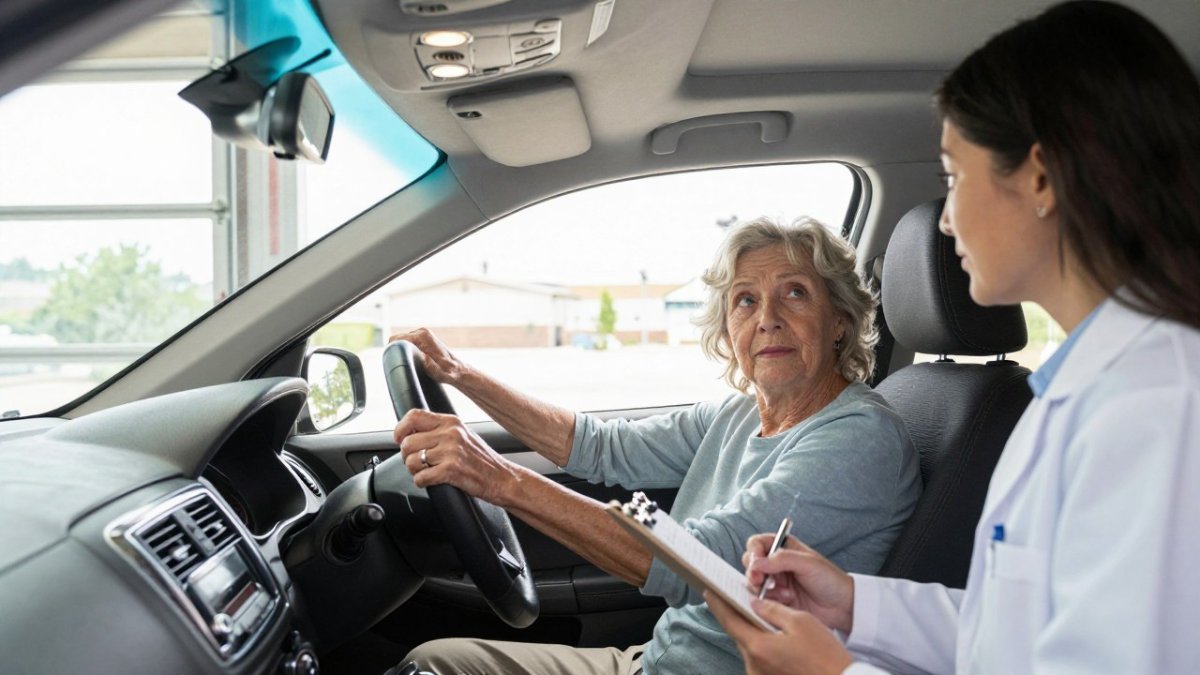
An on-road driving evaluation happens in real traffic with a certified specialist sitting beside the driver. The specialist watches lane position, speed control, signaling, and how the driver handles intersections.
Most people find the off-road part easier to predict, while the on-road part reveals more about real-world behavior. Ask the program which format it offers and what each one covers.
Preparing for Your Senior Driving Evaluation Near Me
A little preparation can make the appointment smoother and less stressful. Many people feel nervous before an evaluation, and that is normal. The goal is not to rehearse the assessment or try to "pass" it. It is to arrive with the information the therapist needs so the results reflect your real abilities on a typical day.
What to bring
Most driver rehabilitation programs ask for a similar packet. Confirm the exact list with the program when you book, because requirements differ.
- A current list of all medications, including over-the-counter drugs, supplements, and anything that can cause drowsiness or affect alertness. Note the dose and when you take each one.
- Your glasses, sunglasses, and hearing aids if you use them, plus any recent vision or hearing exam results.
- Your current driver's license or permit and a photo ID.
How to prepare without rehearsing the assessment
You cannot and should not try to study for a driving evaluation the way you would study for a written test. The therapist needs to see how you actually see, think, and move.
- Schedule the visit for a time of day when you feel most alert, and avoid booking right after a long drive or a poor night's sleep.
- Ask your doctor or pharmacist whether any medication could affect alertness during the appointment, and whether timing matters. Do not change any medication on your own.
- Bring your usual driving shoes and comfortable clothes you would normally wear behind the wheel.
- Eat and hydrate normally beforehand unless a clinician has told you otherwise.
Watch out: arriving tired, rushed, or having skipped meals can make you perform below your normal level, and the therapist may not know the difference. If you are unwell on the day, ask whether to reschedule.
Bringing a support person
Many seniors bring a family member or friend. A support person can help with directions, carry paperwork, take notes during the results discussion, and ask follow-up questions. Some programs welcome this; others prefer to interview the driver alone for part of the visit. Ask when you book so there are no surprises.
If anxiety is making you feel stuck, learn how to reduce driving anxiety with practical strategies before the appointment. For more support, you can also read about overcoming driving anxiety step by step. Returning drivers who have not driven in a while may find it helpful to practice driving after a long break, and anyone who wants structured skill work can try driving practice drills for new drivers.
Costs, Insurance Coverage, and What Results Can Mean
Costs vary widely by program, region, and the type of assessment, and this is one of the most common questions families ask. Rather than quote a single figure, it helps to understand what you are paying for and what to ask before you book.
What the cost usually includes
A driving evaluation is often billed as several components rather than one flat fee. Ask the program to break down its pricing so you can compare options.
- The clinical or off-road assessment, which may be billed by the hour or as a package.
- The on-road evaluation, which is often priced separately and may depend on drive length.
- A written report or summary sent to your doctor or the licensing authority.
- Follow-up visits, retraining sessions, or reassessment, which are usually billed separately.
Questions to ask your insurer and the program
Coverage depends on your plan, your diagnosis, and whether a physician orders the service. Call both your insurer and the program before booking, and get answers in writing where possible.
- Is the evaluation covered as an outpatient occupational therapy service, and does it require a physician referral or prior authorization?
- Is the on-road portion covered, or is it treated as a separate, non-medical service?
- What diagnosis codes will be submitted, and does my plan cover them?
- What is my deductible, copay, or coinsurance for this type of visit?
Confirm your own coverage with your insurer and the program rather than assuming.
What results can mean
Results usually fall into a few groups. Some people receive a clear recommendation to keep driving. Others get advice to drive only in certain conditions, such as daytime, familiar roads, or shorter distances.
An evaluation is a snapshot of skills on one day. It does not predict every future drive, and it does not by itself grant or revoke a license.
If the result is unsafe or inconclusive
This is the conversation families dread, and it helps to have a plan before it happens.
- Ask the therapist to explain which specific skills drove the recommendation, so the next step is targeted rather than vague.
- Ask whether retraining, a period of supervised practice, or a reassessment is appropriate, and on what timeline.
- Ask whether adaptive equipment or vehicle modifications could change the picture, and who evaluates and fits them.
- Start transportation planning early so independence does not depend on a single solution.
Licensing and reporting rules vary
Who can teach someone to drive, who can assess driving skills, and who must report certain medical conditions depends on official rules that vary by jurisdiction. Check your state's licensing requirements and reporting rules directly, and treat the evaluation as clinical input rather than a legal ruling. Find out who can teach or assess driving and what official resources apply.
National Highway Traffic Safety Administration older driver information
American Occupational Therapy Association driver rehabilitation resources
The article breaks down what a driving evaluation involves and what its results can lead to.
| Result type | What it can mean | Next step |
|---|---|---|
| Keep driving | Skills are sound for typical driving | Keep reviewing as needed |
| Conditional | Driving limited to certain conditions | Follow the stated limits |
| Stop driving | Skills are not safe enough currently | Consider equipment or training |
| Inconclusive | Results do not settle the question | Follow-up testing or retraining |
Booking Your Evaluation and Planning Next Steps
Start by asking your doctor or a local driver rehabilitation program for a referral. Confirm the referral requirements, cost, and what the visit includes. Then book a date that gives you time to prepare.
After the evaluation, ask the therapist to explain the results in plain language. Write down any recommendations, such as training, equipment, or changes to when and where you drive.
Planning ahead helps even if the result is positive. If you want a structured way to keep building confidence between visits, the LearnerMiles guided practice membership offers step-by-step practice lessons and a digital practice log you can share with a family coach.
LearnerMiles offers guided lessons and a digital practice log at learnermiles.com for anyone who wants structured practice between professional steps. The free First Drive Kit is available to help you start, and workbook membership is an option when you want more structure.
Frequently Asked Questions
What happens during an occupational therapy driving evaluation?
An occupational therapist usually begins with a review of medical history and medications, then tests vision, visual perception, cognitive skills such as attention and memory, and physical abilities like strength, range of motion, and coordination. Depending on the results, the evaluation may continue with an off-road assessment in a clinic or an on-road drive with a driver rehabilitation specialist. The therapist then explains findings and recommendations. Requirements and procedures vary by provider, so ask what your appointment will include before you arrive.
Who can refer an older adult for a driving evaluation?
In many cases a physician or other licensed clinician can order or recommend a driving evaluation, and some families or the older driver themselves request one directly through an occupational therapy practice. Whether a referral or physician order is needed depends on the provider and the insurance plan. Your primary care doctor is often a good starting point, and they can also tell you whether the evaluation is covered. Check with your provider before scheduling.
What is the difference between an off-road and an on-road driving assessment?
An off-road assessment is conducted in a clinic and tests the physical and cognitive skills tied to driving, such as reaction time, vision, and range of motion. An on-road driving evaluation takes place in a vehicle on public roads with a trained specialist observing driving behaviors and decision-making. Many evaluations include both stages, with the on-road portion occurring only if the off-road results suggest it is appropriate. Results from either part are interpreted by a qualified professional.
Can an occupational therapist determine whether a senior is safe to drive?
An evaluation can identify strengths, limitations, and risks that affect driving, but it cannot guarantee future safety or predict every driving situation. The results are one source of information alongside medical history and the driver's own experience. Legal licensing decisions are made by your state's licensing authority, not by the therapist. Ask the provider to explain the limitations of their findings and what options exist if concerns are identified.
