Last Updated: November 4, 2026
Quick Summary
To master intersection safety, scan early to identify the intersection type, come to a full stop behind the line, and apply right-of-way rules correctly. Practice defensive driving by assuming other drivers may not see you, and always scan for pedestrians and cyclists before moving.
- Identify whether you face a signal, stop sign, yield sign, or no control before the stop line.
- A full stop means the vehicle comes completely to rest behind the stop line or crosswalk.
- At uncontrolled intersections, the first vehicle to arrive goes first and ties yield to the right.
- Keep your wheels straight while waiting to turn left so a rear-end hit won't push you into traffic.
- Traffic already circulating in a roundabout has the right of way over entering drivers.
Table of Contents
- Why Intersections Test Your Judgment, Not Just Your Steering
- Step 1: Scan Early and Identify the Intersection Type
- Step 2: Read Traffic Control Devices and Make a Full Stop
- Step 3: Know Uncontrolled Intersection Right of Way
- Step 4: Learn How to Turn Left at an Intersection Safely
- Step 5: Apply Defensive Driving Intersection Techniques
- Step 6: Adjust for Weather, Visibility, and Modern Vehicle Technology
- Step 7: Protect Pedestrians and Cyclists at Every Crossing
- Frequently Asked Questions
Why Intersections Test Your Judgment, Not Just Your Steering
Many crashes happen where drivers must negotiate with each other, and intersections are a clear example.
Here is the core problem. A new driver can hold a lane and brake smoothly, then freeze at a four-way stop when two cars arrive at once.
That gap explains why intersections feel so stressful. You must scan, predict, decide, and act in seconds.
The Psychology Behind Intersection Errors
Intersection safety is the set of habits that help a driver scan, decide, and act correctly where roads cross. Errors usually come from overload, not carelessness. A learner juggling mirrors, signals, and a passenger's advice can miss a cyclist on the right.
Pressure makes it worse. A parent coaching from the passenger seat may grip the door handle, and the learner reads that as panic. Our advice: agree on calm cues before you drive.
Step 1: Scan Early and Identify the Intersection Type
Start scanning well before the stop line. Identify whether you face a signal, a stop sign, a yield sign, or no control at all. The type tells you what to expect from cross traffic.
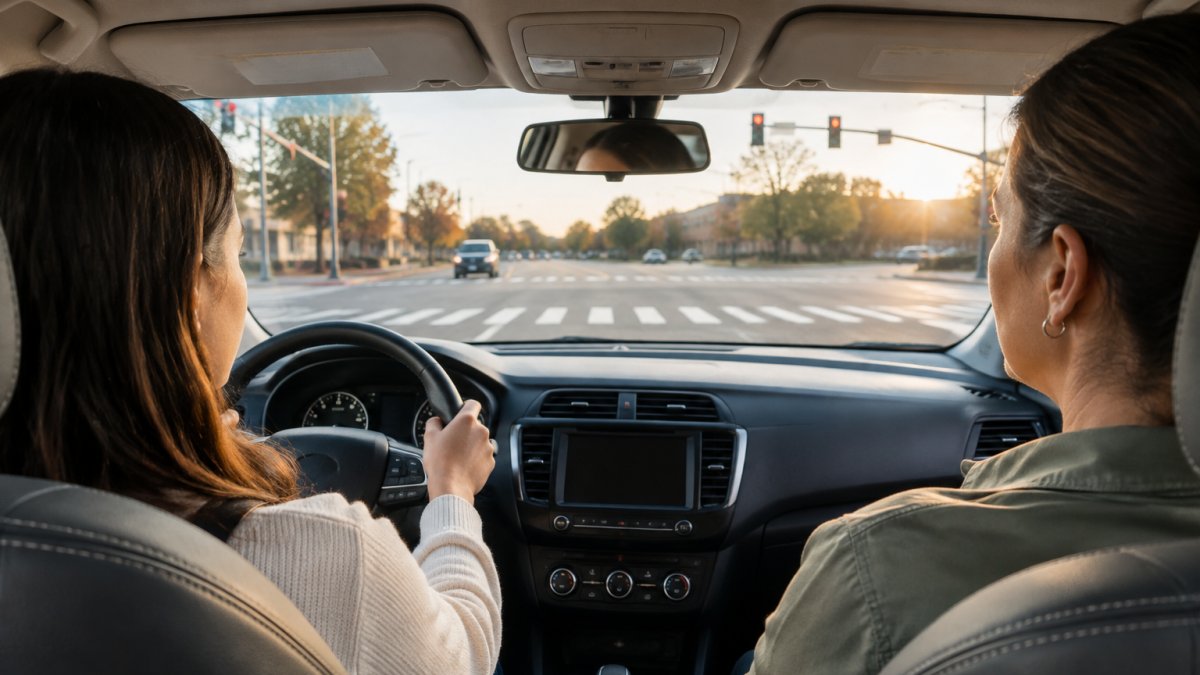
Look for these clues in order:
- Traffic signals and signs overhead or at the corner
- Lane markings, including a turning lane
- Crosswalk stripes and stop lines
- Cars waiting, and their wheel direction
Check blind spots with a quick shoulder glance before you commit. Early scanning gives you time to pick a gap instead of grabbing one.
Step 2: Read Traffic Control Devices and Make a Full Stop
A full stop means the vehicle comes completely to rest behind the stop line, crosswalk, or limit line.
Traffic control devices include signals, signs, and pavement markings. Read them together, not one at a time.
Watch out: stopping past the line blocks the crosswalk and pushes your view into traffic.
For practice-test-style reinforcement of signals and stop lines, work through a Department of Motor Vehicle practice test guide before your next session.
Step 3: Know Uncontrolled Intersection Right of Way
Uncontrolled intersection right of way follows one simple rule: the first vehicle to arrive goes first (Section 7: Laws and Rules of the Road). If two arrive at the same time, yield to the driver on your right.
Right of way is something you give, not take. Never assume another driver will yield just because the rule says they should.
The four-way stop sequence
At a four-way stop, the order of arrival sets the order of departure. The practical problem is that arrival order is often ambiguous, especially when three or four cars roll up within a second of each other. Use this sequence:
- Come to a complete stop and note who is already stopped and who is still rolling.
- Track arrival order across the whole intersection, not just the car directly across from you.
- If two vehicles arrive at the same moment, the driver on the left yields to the driver on the right.
- If you and an oncoming driver arrive together and both want to go straight or turn right, you can usually proceed at the same time because your paths do not cross.
- If you and an oncoming driver arrive together and one of you is turning left across the other's path, the left-turning driver yields.
Watch out: waving another driver through when it is not their turn can create confusion for other drivers. Follow the sequence instead of being polite out of order.
Yield signs and merge-style intersections
A yield sign does not mean stop. It means slow enough to assess and give way if cross traffic is present. The failure mode is treating a yield like a rolling stop and then accelerating into a gap that was never there. Approach a yield sign at a speed that lets you stop if needed, scan the cross road, and commit only when the gap is real.
T-intersections and unmarked crossings
At a T-intersection where your road ends, you yield to all traffic on the through road. At an unmarked crossing with no signs or signals at all, the same first-arrival and yield-to-the-right logic applies, but visibility is often worse, so slow earlier and look for driveways, farm entrances, and alleys that feed the same crossing.
Roundabouts are a different right-of-way system
Roundabouts do not follow first-arrival rules. Traffic already circulating in the roundabout has the right of way, and entering drivers yield to it. Do not stop inside the circle unless traffic ahead forces it.
Use this quick check at any uncontrolled crossing:
- Who arrived first?
- Who is on my right?
- Is anyone signaling a turn?
- Is a pedestrian waiting?
- Is this actually a roundabout, where circulating traffic goes first?
When in doubt, wait. A few extra seconds cost nothing. Right-of-way rules also vary in detail by jurisdiction, so confirm local specifics with your local licensing authority before a road test.
Try the Free First Drive Kit →
Step 4: Learn How to Turn Left at an Intersection Safely
Learning how to turn left at an intersection safely means protecting the turn before you make it.
Watch out: angled wheels mean a rear-end hit can push your car into oncoming traffic. Keep them straight until the gap opens.
Yield to oncoming traffic and to pedestrians in the crosswalk. Clear communication helps here, and our guide on improving driving communication skills covers signals and eye contact.
Step 5: Apply Defensive Driving Intersection Techniques
Defensive driving intersection techniques all rest on one habit: assume the other driver may not see you. Scanning, gap selection, and eye contact with other motorists turn that assumption into action.
Before entering, check for a driver rolling forward, a cyclist in your blind spot, or a pedestrian stepping off the curb. Make eye contact where you can, and confirm with a second look.
Concrete drills build this judgment faster than advice alone. Our list of driving practice drills for new drivers gives you specific scanning and gap-selection exercises to run with a coach, and the LearnerMiles guided practice membership sequences those skills across ten progressive behind-the-wheel lessons so you always know what to work on next.
Step 6: Adjust for Weather, Visibility, and Modern Vehicle Technology
Weather changes everything at an intersection, and each condition changes it differently. Generic advice to leave a bigger gap is not enough, because rain, snow, fog, and low sun each attack a different part of your scan.
Rain
Wet pavement stretches stopping distance and reduces tire grip, so begin braking earlier than you would in dry conditions. The first minutes of rain are often the slickest because oil and dust have not yet washed away. Watch for standing water at the low corner of an intersection, where puddles hide lane lines and crosswalk stripes. Check your local licensing authority for headlight rules in wet weather.
Snow and ice
Snow hides stop lines, crosswalk stripes, and sometimes the curb itself. Look for the physical cues that survive: the position of the traffic signal pole, the plowed edge of the road, and the tracks of cars that stopped before you. Ice is most likely on bridge decks, shaded corners, and approaches where cars brake and idle. Start slowing much earlier and treat every stop as a potential slide.
Fog
Fog removes your ability to see cross traffic approaching, which is the core skill at any intersection. Use low-beam headlights in fog, since high beams can reflect off fog and reduce visibility (Driving in Fog). At a stop sign in heavy fog, crack your window and listen before you commit, and roll forward slowly enough to stop again if a vehicle emerges.
Low sun
Low sun at dawn and dusk can white out a traffic signal entirely. Use the visor, keep the windshield clean inside and out, and if the signal is unreadable, slow down and judge the intersection carefully. Never accelerate through an intersection you cannot see clearly just because the car ahead went.
Modern vehicle technology at intersections
Advanced driver assistance systems help, but they are tuned for common cases and can miss the uncommon ones that cause intersection crashes. Driver-assistance systems are tuned for common cases and may not cover every intersection hazard, so verify what your vehicle's systems do in your owner's manual.
Check these before you rely on any system:
- Are the sensors and cameras clean of snow, mud, and road film?
- Do you know what each warning sound and icon means?
- Does the system work in rain, snow, or direct sun, and does the owner's manual say so?
- Has the system ever stayed silent when a hazard was present?
Treat every alert as information, not permission. You are still the driver, and the system is a second set of eyes that can be blinded by weather, dirt, or an unusual angle.
Step 7: Protect Pedestrians and Cyclists at Every Crossing
Pedestrian awareness at crossings is a core intersection safety rule, not a courtesy.
Before turning right on red where allowed, come to a full stop and look left, then right, then left again for people on foot.
Our guide on how to pass a driving test explains how pedestrian and cyclist awareness at crossings is assessed during the road exam.
| Step | Core Skill | Practice Focus |
|---|---|---|
| 1 | Scan early | Identify intersection type |
| 2 | Full stop | Read signals and stop lines |
| 3 | Right of way | Yield to the driver on your right |
| 4 | Left turns | Protect the turn, keep wheels straight |
| 5 | Defensive driving | Eye contact and gap selection |
| 6 | Weather and tech | Bigger gaps, know your aids |
| 7 | Pedestrians and cyclists | Scan crossings every time |
Nerves are often the real barrier here.
Judgment at intersections is a trainable skill, and it grows fastest with structured repetition.
Frequently Asked Questions
Who turns first at a four-way stop?
At a four-way stop, the first vehicle to come to a complete stop has the right of way. If two vehicles arrive at the same time, the driver on the left yields to the driver on the right. If two vehicles face each other and one is turning left while the other goes straight, the left-turning driver yields. Always confirm with eye contact and a quick scan before moving, since not every driver follows the same order.
How should you approach an uncontrolled intersection?
At an uncontrolled intersection, no signs or signals tell you who goes first, so you rely on right-of-way rules and careful scanning. Slow down, check for cross traffic, and yield to any vehicle already in the intersection or approaching from your right. Look for pedestrians and cyclists too. If visibility is blocked, creep forward until you can see clearly before proceeding. Your local driver handbook explains the exact rules for your area.
What are the most common mistakes drivers make at intersections?
Rolling through stop signs, failing to scan for pedestrians, and misjudging the gap in oncoming traffic are frequent errors. Distracted driving plays a big role, since a quick glance at a phone can hide a cyclist or a changing light. Another common mistake is assuming other drivers will yield. Defensive driving intersection techniques, like covering the brake and making eye contact, help you catch these problems before they become collisions.
How can I reduce driving anxiety at complex intersections?
Break the intersection into steps: scan early, identify the controls, check your gap, and commit only when clear. Practice during quieter traffic hours with a calm coach beside you. At home or parked, you can rehearse relaxation techniques, but never do counted breathing or grounding exercises while the car is moving. If anxiety interferes with daily life, talk with a licensed health professional. A structured practice log can also help you see progress over time.
