
Last Updated: November 19, 2026
Quick Summary
Practice parallel parking in a quiet, empty space such as a parking lot, using a fixed routine of six steps: check mirrors, pull alongside, reverse slowly, turn at the right moment, straighten, and centre within the space. Repeat each step until it feels steady before combining them.
- Start in an empty lot or quiet street with little traffic and no pedestrians nearby.
- Stop with your side mirror lined up with the other car's windows, about two to three feet away.
- Reverse slowly and start turning when your mirror lines up with the parked car's rear bumper.
- Turn the wheel back when the car is roughly parallel to the curb, making small corrections.
- Practice in short sessions, moving up one step only when the current one feels consistent.
Table of Contents
- Why Parallel Parking Feels Hard and How Practice Fixes It
- Choosing a Safe Space to Practice Parallel Parking
- Step-by-Step Parallel Parking Method for Beginners
- Practice Parallel Parking at Home Without Cones
- Safety Checks and Traffic Awareness During Practice
- Parallel Parking Tips for the Driving Test
- Tracking Progress and Building Your Next Practice Session
- Frequently Asked Questions
Why Parallel Parking Feels Hard and How Practice Fixes It
Parallel parking is one of the skills new drivers worry about most. LearnerMiles, a guided practice companion for new drivers and their coaches, is built around the idea that a skill this awkward becomes manageable when it is broken into small, repeatable steps.
Parallel parking feels hard for a simple reason: it asks you to judge distance, angle and steering at the same time, while watching mirrors and traffic. Most people have never done that before. Practice turns those separate judgments into habits you no longer have to think about.
A few things make the first attempts especially frustrating:
- Depth perception from a driver's seat is hard to judge at first.
- Mirror checks feel slow and unnatural.
- Steering timing is easy to get wrong when you are reversing.
- Pressure from a waiting driver or coach makes small errors feel bigger.
Practice fixes most of this by letting you make mistakes in a calm, low-stakes place. Each session shows you one thing to improve, so you are not trying to master everything at once.
Watch out: rushing the first attempts on a busy street is the fastest way to build fear around this skill. Start somewhere quiet and slow.
Choosing a Safe Space to Practice Parallel Parking
The best place to practice is an empty parking lot or a quiet residential street with little traffic. Look for a space with clear markings, no pedestrians nearby and enough room to pull out without hitting anything.
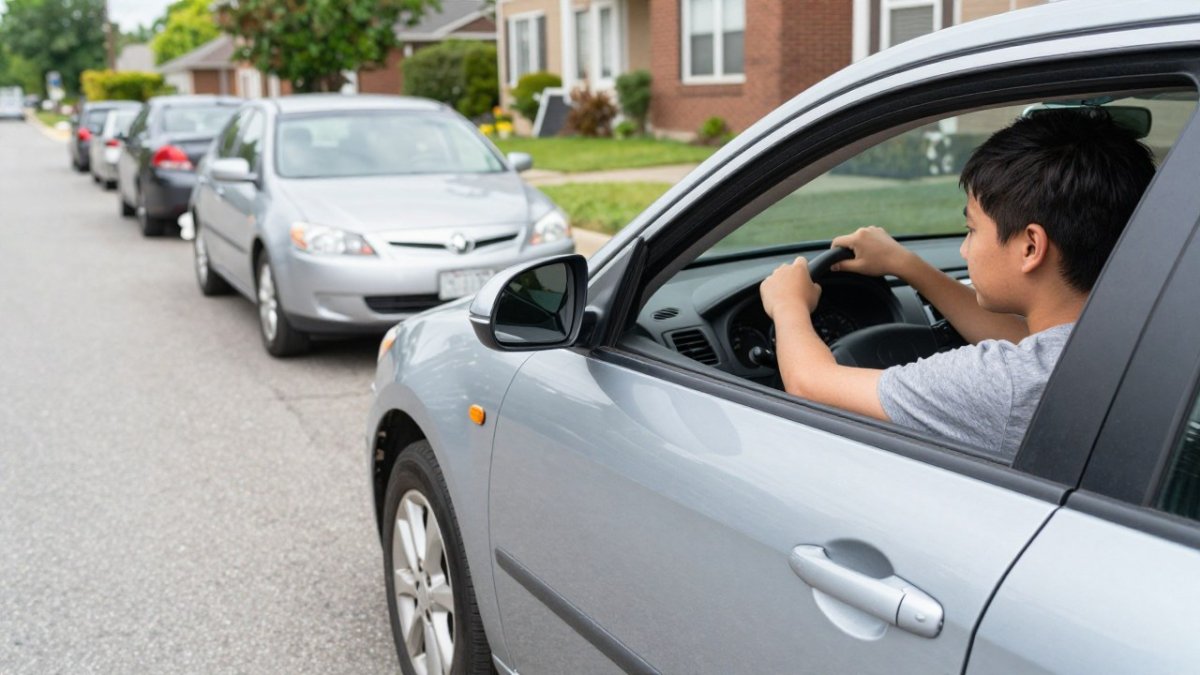
Use a space that fits your learning stage:
- Beginners: An empty lot with two cones or cardboard boxes set about a car length apart.
- Building skill: A quiet street with parked cars on one side and light traffic.
- Near test-ready: Spaces that look like the real test environment, with curbs and other vehicles.
Always check local rules before parking practice on public streets. Some areas restrict practice, and a parent-supervised session is not the same as a formal driver education program. For the rules that apply where you live, check your local licensing authority, such as your state DMV or MVA.
Be sure the learner and the coach agree before starting. A short conversation about what to do if things go wrong helps both people stay calm. You can set this up with LearnerMiles' coach-learner communication agreement, which gives both sides a shared plan before the car moves.
Step-by-Step Parallel Parking Method for Beginners
Use the same routine every session. Repetition builds the muscle memory that makes parallel parking feel natural.
- Scan and check mirrors. Look over both shoulders and check the mirrors for cars, cyclists and pedestrians.
- Pull alongside the parked car. Line up your side mirror with the other car's side windows, about two to three feet away.
- Reverse slowly. Shift to reverse and keep your speed very low.
- Turn the wheel at the right moment. Start turning when your mirror lines up with the rear bumper of the parked car.
- Straighten as you enter. Turn the wheel back when the car is at an angle that looks roughly parallel to the curb.
- Centre within the space. Adjust with small forward and reverse movements until you are close to the curb and evenly spaced.
Practice each step separately before combining them, so each part of the routine is steady before the steps are linked together.
Positioning Beside the Vehicle in Front
Position matters more than speed. Stop with your rear bumper roughly aligned with the rear bumper of the car you plan to park behind, and keep about two to three feet between the cars.
Use simple reference points to check your position:
- The side mirror should line up with the other car's windows.
- A point on your car, such as the back of the window frame, should line up with the other car's rear bumper.
- Keep your car close enough to the curb side that you can judge the gap without leaning forward.
Reference points differ between vehicles. A taller SUV or a small hatchback will show you the space differently, so take a few minutes to find the points that work for your car.
Reversing, Turning and Straightening
Reverse slowly, using the brake to control speed. Look over your right shoulder through the rear window and check your mirrors often.
Turn the steering wheel when your mirror points at the rear bumper of the parked car. Then turn it back when your car is roughly parallel to the curb. Expect to make small corrections, and do not turn the wheel all the way in one motion.
Common mistakes to avoid:
- Turning too early pushes the rear of the car toward the curb.
- Turning too late leaves you too far from the curb.
- Using too much speed makes each correction harder.
The method breaks into six steps, and the main timing and position cues are easy to scan.
| Step | What to do | Key cue |
|---|---|---|
| Scan and check mirrors | Look over both shoulders and check mirrors | Cars, cyclists, pedestrians |
| Pull alongside | Line up side mirror with the parked car's windows | About two to three feet away |
| Reverse slowly | Shift to reverse and keep speed very low | Low speed |
| Turn the wheel | Start turning when mirror lines up with rear bumper | Rear bumper alignment |
| Straighten | Turn wheel back when car is roughly parallel to curb | Roughly parallel to curb |
| Centre within space | Adjust with small forward and reverse movements | Close to curb, evenly spaced |
Practice Parallel Parking at Home Without Cones
You do not need a full parking lot or a set of cones to build this skill. A driveway, a wide empty street, or a parking lot at a quiet time of day can work.
A common pattern among coaches is to treat home practice as a ladder rather than a single drill. Each rung adds one new demand, and you only climb when the current rung feels steady.
Rung 1, Still and stationary. Park the car, engine off, and walk the space.
Rung 2, Straight-line reversing. With the space marked but no turn required, reverse slowly in a straight line and stop with your rear bumper inside the marked zone.
Rung 3, Single turn in. Add the first steering input only. Reverse, turn once at your chosen reference point, and stop. Do not try to finish the park.
Rung 4, Full maneuver, no traffic. Complete the whole sequence, turn in, straighten, adjust, with markers only. Milestone: the car finishes roughly parallel to the curb line and inside the marked zone on most attempts.
Rung 5, Full maneuver beside a real vehicle. Repeat next to a parked car in a quiet area, with a coach watching. Milestone: you can complete the park and explain afterward which reference points you used.
Keep sessions short. Ten to fifteen focused minutes often teaches more than an hour of tired, rushed attempts, and a short session you can repeat tomorrow beats a long one that ends in frustration.
After each session, note which rung you worked on and whether you met its milestone.
Safety Checks and Traffic Awareness During Practice
Safety comes first in every session. Before you move the car, check:
- Mirrors and blind spots, looking over both shoulders.
- Pedestrians, cyclists and children nearby.
- Traffic approaching from behind, especially on a street.
- Any obstacles that could hit the car when you reverse.
Keep your speed very low, and stop if you are unsure. A coach should be ready to say stop, and the learner should know that stopping is always a good choice.
If you feel overwhelmed or cannot keep control of the car, stop safely as soon as conditions allow. Put the car in park, take a short break and talk through what happened before trying again. If stress keeps getting in the way, talk with a qualified driving instructor or a licensed health professional for support.
Parallel Parking Tips for the Driving Test
Test examiners look for control, awareness and steady progress more than perfect technique. Keep these points in mind:
- Check traffic before every move. Examiners notice when a driver checks mirrors and shoulders.
- Move slowly and smoothly. Jerky steering and fast reversing are common reasons for lost points.
- Stay calm if you make a correction. A small, controlled fix is better than a rushed one.
- Practice in the same kind of space the test uses, such as a space between two parked cars on a quiet street.
Requirements for the test, including which maneuvers are included, vary by jurisdiction. Check your local licensing authority for the exact rules and what the examiner will score.
Tracking Progress and Building Your Next Practice Session
Progress is easier to see when you write it down. A simple practice log helps learners and coaches decide what to work on next. LearnerMiles includes a digital practice log that records each session, so the next practice can focus on the step that needs the most work.
Track these details after each session:
- The date, time and location.
- Which step you practiced, such as positioning or reversing.
- One thing that went well.
- One thing to improve next time.
- How confident you felt, on a simple scale from one to five.
Use this record to plan the next session. If positioning is strong but straightening is weak, spend the next practice on the straightening step. Over time, the log shows whether your parking is getting smoother and more consistent.
A progress record shows practice, not a guarantee. Logged hours and confidence scores can help you plan, but they do not replace required education or prove that you are ready for a test. Check your local licensing authority for any required hours or steps.
When you are ready to plan your next session, explore LearnerMiles' guided lessons and digital practice log to keep your coach and learner on the same page.
Frequently Asked Questions
Is there a trick to parallel parking?
There is no single trick, but a repeatable routine helps most. Pick a reference point, such as the rear bumper of the parked car alongside your target, and use it consistently. Stop with your mirror lined up with that point, turn the wheel fully toward the curb as you reverse, then straighten once the front of your car clears the other vehicle. Practicing the same sequence at low speed builds the muscle memory that makes the maneuver feel automatic.
How can beginners practice parallel parking safely?
Start in an empty parking lot or quiet street with no traffic, and use markers such as cones or bags only if they are placed well away from traffic. Move slowly and keep your speed low throughout. Check your mirrors and look over your shoulder before every reverse movement. Stop if you feel rushed or lose concentration, and move to a safe stop before continuing. Parent-supervised practice should follow your local licensing authority's rules on who may supervise and where a learner may drive.
How do you practice parallel parking without cones or other cars?
You can set up a practice space by marking a rectangle on a lot with two objects roughly one car length apart, or by using a spot between two legally parked cars during a quiet period. Measure the space with a parked car or by counting your car lengths before you start. Practicing without cones is useful for building judgment, but test a space's clearance carefully before reversing into it, and never reverse into an area you cannot see clearly.
Do you fail a driving test if you can't parallel park?
Whether parallel parking is included on a road test depends on your state and testing location, so check with your local licensing authority, such as the DMV or MVA in your state, for the exact maneuvers scored. Passing the test depends on demonstrated driving skill and safe control rather than on any single maneuver alone. Consistent practice that covers the steps in this guide gives you the best chance of performing well if the maneuver is part of your test.
