
Last Updated: October 30, 2026
Quick Summary
Improve defensive driving habits by scanning 12 to 15 seconds ahead, checking mirrors on a regular routine, keeping a three-second following distance, and practicing one focus habit per session. Log each drive and review it before the next one.
- Look at least 12 to 15 seconds ahead, or as far as conditions safely allow.
- Check the rearview mirror, the side mirror, and your blind spot before any lane change.
- Count three seconds behind the car ahead, and add time in rain, at night, or on wet roads.
- Choose one primary habit and at most one secondary habit for each practice drive.
- Record the date, focus habit, conditions and next step in a practice log after each drive.
Table of Contents
- Why Defensive Driving Habits Matter for New and Returning Drivers
- Scan the Road and Anticipate Hazards Early
- How to Check Mirrors While Driving
- Following Distance While Driving: A Measurable Approach
- Defensive Driving Techniques for Weather, Darkness, and Poor Visibility
- Building a Defensive Driving Practice Plan You Can Follow
- Your Next Step: Start Practicing Your Habits This Week
- Frequently Asked Questions
Why Defensive Driving Habits Matter for New and Returning Drivers
Defensive driving means expecting mistakes from other drivers and planning for them before they happen.
Many new drivers feel nervous behind the wheel. That nerves often comes from not knowing what to look for next.
Defensive habits also matter for drivers returning after a long break. Skills fade when they are not used.
Here is what defensive driving usually includes:
- Watching the road ahead well beyond the car in front
- Checking mirrors on a regular rhythm
- Keeping enough space to stop or steer around trouble
- Signaling early so other drivers can plan
- Staying off the phone and other distractions
Licensing rules, minimum ages, and required practice hours vary by jurisdiction. Contact your local licensing authority for the rules that apply to you.
Scan the Road and Anticipate Hazards Early
Good drivers look far ahead and think about what could happen next. This is called hazard perception.
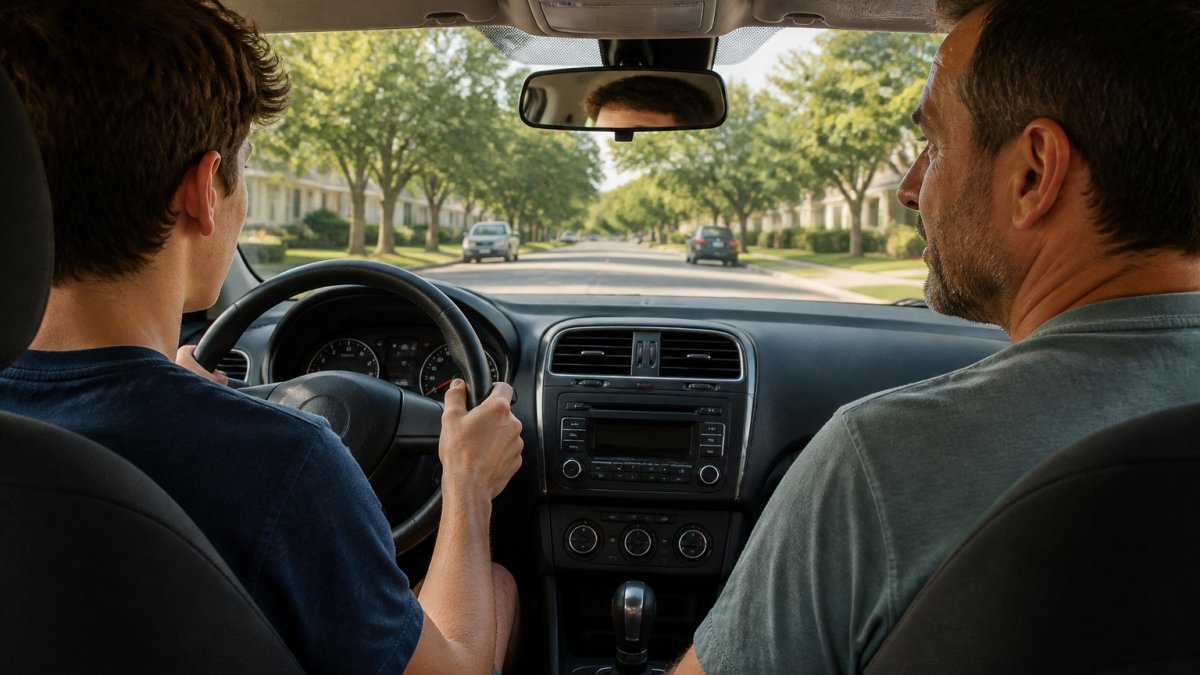
A simple habit helps. Look at least 12 to 15 seconds ahead on the road, or as far as safe conditions allow.
Practice these scanning habits during supervised sessions:
- Name one possible hazard out loud every few blocks, such as a parked car door opening or a ball rolling into the street
- Watch pedestrians near curbs and crosswalks
- Notice brake lights three or four cars ahead
- Check intersections for cross traffic before you reach them
Watch out: Staring at one spot, often the bumper of the car ahead, is a common learner mistake.
Parents and coaches can help by asking, "What do you see coming up?" during drives.
How to Check Mirrors While Driving
Mirror checks give you information about traffic behind and beside you. Learners often check mirrors too rarely or too quickly to notice anything.
Adjust your mirrors before you start moving. Set the rearview mirror so you see the full rear window.
Then make a regular check part of your routine:
- Check the rearview mirror before slowing, stopping, or changing lanes
- Check the side mirror on the side you plan to move toward
- Glance over your shoulder at the blind spot before any lane change
- Repeat the sequence before pulling away from a stop
Blind spots are areas beside and slightly behind the car that mirrors do not fully show. A quick head turn closes that gap.
Following Distance While Driving: A Measurable Approach
Following distance is the space between your car and the vehicle ahead. Enough space gives you time to react when the car in front brakes suddenly.
A widely taught method is the three-second rule. Pick a fixed object, like a sign or a tree, on the roadside.
Use these steps during practice:
- Choose a fixed roadside object ahead of the car in front
- Count three seconds after the car passes it
- Add one more second in rain, at night, or on wet roads
- Leave more space when following large trucks or motorcycles
The three-second rule is a starting guideline, not a fixed legal requirement. Some jurisdictions' laws and driver manuals describe following distance differently.
Defensive Driving Techniques for Weather, Darkness, and Poor Visibility
Weather and low light make every defensive habit harder, and they change the numbers behind the habits. Wet pavement lengthens stopping distance, glare hides hazards, and fog removes the cues you normally use to judge spacing. The fix is not a single tip but a set of adjustments to speed, spacing, and visibility checks that you apply before conditions get bad.
Try the Free First Drive Kit →
Adjust spacing, not just speed
Following distance should grow as conditions worsen. If you use the three-second method in good conditions, add time in rain, at night, or on wet roads, and add more in fog, snow, or heavy rain. The reason is mechanical: stopping distance grows with lower traction and reduced visibility, so the gap that felt safe in daylight can be too short at dusk. Leave extra room behind large trucks and motorcycles, which have different stopping and visibility profiles.
Make visibility checks a routine
Poor visibility is as much about being seen as seeing. Turn on headlights when visibility drops, including at dusk and during rain, so other drivers can spot you earlier. Keep the windshield, wipers, and mirrors clean and clear, because streaks and grime scatter light and worsen glare. When glare from oncoming headlights is strong, look toward the right edge of your lane as a reference rather than staring into the lights.
Handle high-risk conditions step by step
- Rain and wet roads: slow down before you need to brake, avoid sudden lane changes, and increase the gap ahead.
- Fog: use low-beam headlights, increase spacing further, and avoid stopping on the shoulder unless necessary.
- Snow and ice: brake and steer gently, leave much more room, and expect longer stopping distances.
- Darkness: watch for pedestrians and cyclists outside crosswalks, and reduce speed where visibility is limited.
Build comfort gradually
Practice in mild conditions first. A familiar route on a light rain day with a supervising adult builds comfort before heavy rain or a dark highway. Some learners feel more anxious in poor conditions, and that feeling is normal. Choose calmer times to practice, and if you feel unable to focus or maintain control, stop safely as conditions allow and seek appropriate support.
Rules about headlight use, speed for conditions, and required equipment vary by jurisdiction. Check your local licensing authority and driver's handbook for the standards where you drive.
Building a Defensive Driving Practice Plan You Can Follow
Most defensive driving advice stops at a list of tips. The harder question is how to turn those tips into habits that show up automatically on an ordinary trip. That takes a routine: pick a small number of behaviors, practice them on purpose, track what happened, and review before the next drive. This is the part most guides skip, and it is where real improvement happens.
Step 1: Pick one or two habits per session
Trying to fix scanning, spacing, signaling, and mirror checks all at once overloads a learner. Choose one primary habit and, at most, one secondary habit for each practice drive. A coach can help by naming the focus before the car moves: "Today we are working on following distance. I will ask you about the gap at stoplights."
Step 2: Use a pre-drive check to set up the habit
A short pre-drive routine makes the habit easier to practice. Before pulling out, confirm mirrors are set, the seat and steering position are comfortable, headlights and signals work, and the route matches the skill you are practicing. Quiet residential streets suit mirror and spacing work; busier roads suit scanning and merging once the basics are steady.
Step 3: Practice on purpose, not just by driving
A habit needs repetition in the same conditions. If the focus is following distance, practice the counting method on a stretch of road with steady traffic and say the gap out loud. If the focus is scanning, have the learner narrate hazards every few blocks. Short, focused drives beat long, tiring ones because attention holds up better.
Step 4: Log what happened
A simple log entry after each drive keeps progress visible. Record the date, the focus habit, the conditions (day, night, rain, traffic level), what went well, and one thing to work on next time. Patterns emerge quickly: a learner may scan well in daylight but drop the habit at dusk, or hold spacing on local roads but tighten up on the highway. A practice log can make those patterns easier to notice and share with a coach.
Step 5: Review before the next session
Spend two minutes before the next drive reading the last entry and choosing the focus. This closes the loop so each session builds on the last instead of repeating the same random trip.
A sample progression might move from mirror checks and smooth starts in quiet areas, to scanning and following distance on local roads, to intersections, merging, and changing conditions once the earlier habits feel steady. Adjust the pace to the learner; there is no fixed number of sessions that fits everyone.
Parent-supervised practice is not the same as a formally authorized parent-taught driver education program.
You can explore LearnerMiles guided lessons and the digital practice log at learnermiles.com.
For more ideas, read 10 Driving Practice Drills for New Drivers. Parents planning supervised sessions may also find Structured Driving Practice for Parents: A 2026 Guide useful. If you are restarting after a long gap, see How to Practice Driving After a Long Break. Anyone who feels nervous behind the wheel can also review Best Ways to Reduce Driving Anxiety: A Step-by-Step Guide before building new habits.
The steps below summarise how to turn defensive driving tips into a repeatable practice routine.
| Step | What to do | Time or frequency |
|---|---|---|
| Pick a focus | Choose one primary habit and at most one secondary habit | Each practice drive |
| Pre-drive check | Confirm mirrors, seat, steering, headlights and signals | Before pulling out |
| Practise on purpose | Repeat the habit in the same conditions, narrating out loud | Short, focused drives |
| Log the drive | Record date, focus habit, conditions, what went well and next step | After each drive |
| Review | Read the last entry and choose the next focus | Two minutes before the next drive |
Your Next Step: Start Practicing Your Habits This Week
Pick one habit from this guide and practice it on your next drive. Start with scanning ahead or with the mirror routine.
Talk with your coach or supervising adult about which habit to focus on first. Agree on a simple way to give feedback that keeps the mood calm.
Ready to turn these habits into a plan? Explore LearnerMiles guided lessons and the digital practice log at learnermiles.com.
Frequently Asked Questions
Why should drivers practice defensive driving?
Defensive driving means anticipating what other road users might do and leaving yourself time and space to respond. Practicing it turns scanning, spacing, and signaling into automatic habits, so you are not relying on memory during a sudden stop or lane change. Habits built during calm practice are the ones most likely to show up when traffic gets stressful. Check your state's licensing authority for any formal requirements, since practice alone does not replace required education or testing.
How often should I check my mirrors?
Check your rearview and side mirrors regularly, not just once at the start of a trip. Good practice is to glance at them before slowing, before changing lanes, before turning, and whenever traffic around you shifts. Make the check a routine part of every decision rather than a reaction to a problem. Mirror checks work best alongside a shoulder check for blind spots, which mirrors alone cannot cover.
How can new drivers practice defensive driving with a coach?
Agree on the goals before the drive, such as which habits to focus on and how feedback will be given. During practice, have the coach call out hazards and ask the learner to describe what they are watching for. After the drive, review two or three specific moments together rather than everything at once. Keeping a simple log of practice sessions helps both sides see progress over time and keeps feedback calm and specific.
What should I do if I feel too distracted or anxious to drive safely?
If you cannot keep control or concentration, stop safely as soon as conditions allow, such as pulling into a parking lot, and stay parked until you feel steady. Do relaxation exercises only when the car is parked, never while moving. If anxiety keeps interfering with everyday driving, talk with a qualified driving instructor or a licensed health professional. Persistent symptoms deserve professional support rather than being treated as harmless nerves.
