

Table of Contents
- Understanding the Department of Motor Vehicle Practice Test
- How to Pass Your Driving Test: A Step-by-Step Preparation Plan
- Behind-the-Wheel Practice Requirements and How They Connect to the Written Exam
- Driving Test Anxiety Tips: Building Confidence Before Exam Day
- Common Mistakes to Avoid on Your Practice Test
- What to Bring and How to Prepare for Test Day
- Frequently Asked Questions
Last Updated: October 2, 2026
Understanding the Department of Motor Vehicle Practice Test
A motor vehicle practice test is a study tool that mimics the official written knowledge exam you'll take at your local DMV or motor vehicle agency.
The written test matters: you can pass it and still freeze behind the wheel if you've missed critical safety rules. A motor vehicle practice test catches those gaps before test day.
What the Knowledge Test Covers
Your state's motor vehicle practice test covers three core areas: traffic laws (speed limits, parking, right-of-way, traffic signals), road signs (warning, regulatory, informational), and safe driving principles (defensive techniques, hazard handling, emergencies).
Content varies by state; your state's driving manual is the official source for what will appear on your test.
Multiple-Choice Format and Passing Score Requirements
Most state tests use multiple-choice questions with four options; passing scores range from 70-80% depending on your state. Question counts vary (typically 30-50). Check your state's DMV website for exact requirements before you study.
How to Pass Your Driving Test: A Step-by-Step Preparation Plan
Passing your motor vehicle practice test requires three things: understanding the material, practicing repeatedly, and identifying weak spots.
Step 1: Review Your State's Driving Manual
Download your state's official driving manual from your state DMV website or pick up a physical copy. Read it cover to cover and take notes on rules that surprise you. Many test failures stem from misunderstanding a single rule, for example, right-of-way at four-way stops. Re-read confusing sections; repetition builds memory.
Step 2: Study Traffic Signs and Road Safety Rules
Traffic signs are a major test category. Create flashcards or use a digital tool to drill signs by shape and color: red (stop, yield, do not enter), yellow (warning, construction), green (directions, exits), white (regulatory, speed limits). Road safety rules, handling skids, brake failure, bad weather, require understanding the reasoning, not just memorizing the rule.
Step 3: Take Practice Exams and Sample Questions
Take at least three full-length practice exams using official state DMV questions or reputable study apps. After each test, review every wrong answer and understand why the other options are wrong, this builds reasoning skills for tricky questions.
Step 4: Track Your Progress and Identify Weak Areas
Track your scores and note which topics trip you up most. Spend extra time on weak areas by re-reading relevant manual sections and taking additional practice questions in that category. Targeted review works better than general study.
Behind-the-Wheel Practice Requirements and How They Connect to the Written Exam
Your written knowledge supports your practical driving. You can't drive safely without understanding the rules you'll be tested on.
Minimum Practice Hours by State
Most states require 50-100 hours of supervised practice before the road test; your state DMV specifies the exact number and nighttime requirements. Quality practice, where you and your coach discuss what you're learning, matters more than just logging hours.
Why Written Knowledge Supports Practical Driving
Understanding rules deeply improves decision-making: you know why you yield at four-way stops, recognize warning signs, and understand right-of-way. The written test forces you to think about these rules before road pressure, reducing panic and building confidence.
Driving Test Anxiety Tips: Building Confidence Before Exam Day
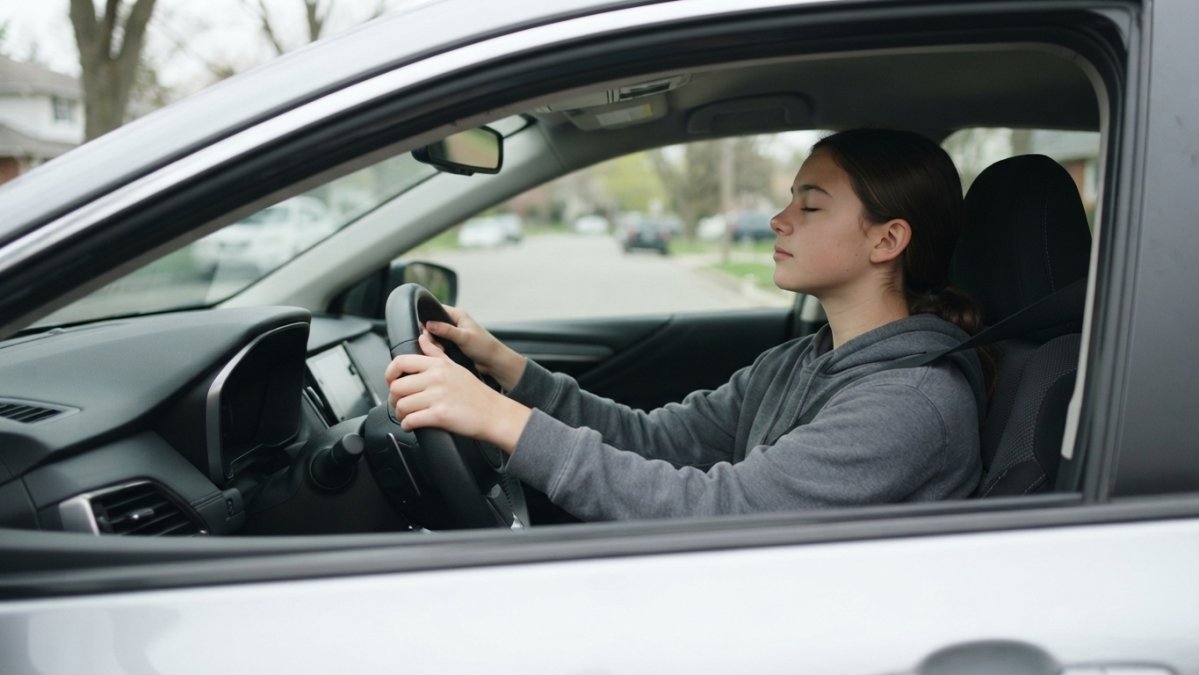
Test anxiety is real and common: your brain goes blank, hands shake, and you second-guess correct answers. This isn't a sign you're unprepared, it's your nervous system in fight-or-flight mode, which narrows focus and increases error.
Understanding How Anxiety Affects Test Performance
Anxiety causes three errors: (1) misreading questions and missing "not," "except," or "unless"; (2) rushed processing where the first plausible answer feels right; (3) decision paralysis where you freeze between two answers. Recognizing these patterns before test day is the first step to preventing them.
Mental Rehearsal: The Most Effective Anxiety Reducer
Mental rehearsal, visualizing yourself taking the test successfully, reduces anxiety more than cramming. One week before, spend 5 minutes each evening imagining yourself in the testing room, reading questions slowly, considering all options, and selecting answers with confidence. Three days before, add a layer: imagine encountering a tricky question, pausing to breathe, working through it methodically, and getting it right.
Concrete Techniques for Test Day
Before you start: Arrive 20 minutes early. Do a body scan (notice your feet, back, hands) to ground yourself.
During the test: Read each question twice, first for understanding, second to identify key constraints ("not," "except," "safest"). If panic rises, pause and do one round of box breathing.
Building Confidence Through Structured Practice
Preparation is the best antidote to test anxiety. Taking five full-length timed practice tests makes the real test feel familiar and builds self-efficacy, the belief that you can handle the task.
Common Mistakes to Avoid on Your Practice Test
Most test-takers make the same mistakes repeatedly. Understanding why these errors occur, not just what they are, is the key to avoiding them on the real test.
Mistake 1: Misinterpreting Right-of-Way Rules
Why it happens: Right-of-way rules are hierarchical and context-dependent; test-takers often memorize one rule and miss exceptions.
How to practice: Sketch four-way stop scenarios with two cars arriving simultaneously and label which yields. Do this 10 times to lock in spatial logic.
Common trick: "You have a green light to turn right, but a pedestrian is crossing against the signal.
Mistake 2: Confusing Similar Traffic Signs
Why it happens: Under stress, your brain defaults to pattern-matching by color, not precise shape identification.
How to practice: Study signs by shape first, color second.
Common trick: "You see a yellow diamond sign with a left-turn arrow." Answer: Left turn ahead; be prepared to turn or yield to oncoming traffic.
Mistake 3: Rushing Through Questions Without Reading Carefully
How to practice: Read each question twice before looking at answers, first for meaning, second to identify constraint words.
Constraint-word checklist: Does the question ask what is or not correct? Does it ask for "safest," "most likely," or "best"?
Common trick: "You are driving on a wet road and your vehicle skids.
Mistake 4: Confusing State-Specific Rules
Why it happens: If you've driven in another state or studied with a friend from a different state, you might have conflicting rules in your head.
How to practice: As you take practice tests, note any question where you weren't sure if the rule was state-specific. Look it up in your state's driving manual. If it's state-specific, write it down and review it weekly.
Putting It Together: The Error-Analysis Protocol
After each practice test, don't just look at your score. Analyze your errors:
- Categorize each wrong answer: Was it a right-of-way error, a sign error, a misread, or a knowledge gap?
- Identify the pattern: Did you miss all four-way stop questions? Did you confuse yellow signs? Did you miss the word "not" in three questions?
- Target your review: Spend the next study session on that specific category.
- Take another practice test: See if your error rate in that category dropped.
This targeted approach works far better than general review. You're not just studying harder; you're studying smarter.
What to Bring and How to Prepare for Test Day
Required Documents and Materials
Check your state DMV website for the exact list. Most states require:
- A valid photo ID
- Your learner's permit or application confirmation
- Proof of residency (utility bill, lease, or similar)
- Your Social Security number or tax ID
Bring originals, not copies. Arrive at least 15 minutes early to allow time for check-in.
Final Preparation the Night Before
Don't cram. Your brain won't retain new information the night before the test.
Get a full night of sleep. Sleep consolidates memory.
Eat a good breakfast on test day. Low blood sugar makes anxiety worse and thinking harder.
Taking a department of motor vehicle practice test is your chance to identify gaps before the official exam.
If you're feeling overwhelmed by the studying process or struggling to know what to practice next, consider using a structured learning platform. LearnerMiles provides guided lessons and a digital practice log that helps you track progress and stay organized as you prepare for both your written test and behind-the-wheel practice. Explore guided lessons and the digital practice log at learnermiles.com.
Frequently Asked Questions
How many questions are on the official state driving test?
The number of questions varies by state, typically ranging from 30 to 50 multiple-choice questions on the written knowledge test. Your state's Department of Motor Vehicles website lists the exact number for your exam. Check your state's driver's manual or licensing authority website for the specific format and question count you'll encounter.
What's the best way to study for the learner's permit test?
Start by thoroughly reviewing your state's official driving manual, focusing on traffic laws, road signs, and right-of-way rules. Take multiple practice exams to identify weak areas, then review those topics again. Space your study sessions over several weeks rather than cramming the night before. Practice tests help you understand the format and build confidence before the actual exam.
How can I overcome test anxiety before my driving exam?
Recognize that some nervousness is normal and manageable. Use breathing techniques like deep, slow breaths to calm your nervous system before and during the test. Practice regularly so the material feels familiar, which reduces uncertainty. Get adequate sleep the night before, eat a good breakfast, and arrive early to familiarize yourself with the testing environment. Structured practice builds genuine confidence.
Are online practice tests accurate to the real exam?
Quality online practice tests that mirror your state's official format are generally accurate and helpful for preparation. However, the most reliable practice comes from your state's official DMV website or approved study materials. Use multiple practice sources to expose yourself to different question styles, but verify that the content aligns with your state's current traffic laws and regulations.