

Quick Summary
A 14-year-old in Louisiana can often start driver's ed at 14 for classroom instruction, but starting a course and starting to drive follow separate rules. Confirm the course minimum with the provider and the permit age with the Louisiana Office of Motor Vehicles before enrolling.
- Enrolling in a course and getting a permit are separate milestones with different minimum ages.
- The provider sets its own enrollment window, and the state sets what the course must contain.
- A Temporary Instructional Permit (TIP) is a licensing rule, not a course-start rule.
- Confirm current document lists and fees directly with the Louisiana OMV before applying.
- Check whether behind-the-wheel hours are included in the course or sold separately.
Table of Contents
- Starting Driver's Ed Versus Starting to Drive in Louisiana
- Louisiana Minimum Ages: Reconciling the Conflicting Numbers
- Louisiana TIP Card Requirements at 14
- Enrolling in a Driver Education Course: Steps and Documents
- Building Behind-the-Wheel Practice for Teen Drivers
- Managing Driving Anxiety in New Teen Drivers
- Your Next Step: Confirm Eligibility With Louisiana OMV Before Enrolling
- Frequently Asked Questions
Can You Start Driver's Ed at 14 in Louisiana?
Last Updated: November 5, 2026
Starting Driver's Ed Versus Starting to Drive in Louisiana
Yes, a 14-year-old in Louisiana can often start driver's ed, but starting a course and starting to drive are two separate steps with different rules, so families asking about driver's ed at 14 should check both. Families weighing other formats can compare alternatives to traditional classroom driver's ed. Many families mix them up, which leads to missed deadlines and wasted paperwork. This guide explains where the two steps differ and what to confirm with the Louisiana Office of Motor Vehicles (OMV) before enrolling.
Driver's ed is the classroom and behind-the-wheel training a teen completes. Starting to drive is a licensing question: when a teen may legally sit behind the wheel with a learner's permit or Temporary Instructional Permit (TIP). Those two clocks run on different schedules.
The most reliable way to avoid confusion is to check the age rules for each step separately with the official source. Louisiana OMV driver licensing requirements
Louisiana Minimum Ages: Reconciling the Conflicting Numbers
Online sources give different ages for Louisiana teens, and the conflicts are real. Some online sources list different ages for classroom instruction and permits. These figures can describe different milestones, so confirm each one against the current official source before planning.
Here is how to sort them out:
- Enrolling in a driver education course: This is a provider and state question. A course may accept a teen at 14 for classroom instruction, but the provider sets its own enrollment window, and the state sets what the course must contain. Confirm the course minimum with the provider and cross-check it against the Louisiana Office of Motor Vehicles (OMV).
- Receiving behind-the-wheel instruction: Classroom and behind-the-wheel training are often bundled, but they are not always available at the same age. Ask the provider directly when the in-car portion begins.
- Applying for a Temporary Instructional Permit (TIP): The TIP is the document that lets a young teen practice under supervision. Its age threshold is a licensing rule, not a course rule, and it is often confused with the course-start age.
- Applying for a learner's permit: The standard learner's permit has its own minimum age, set by the state. This is the stage most teens associate with 'learning to drive.'
- Earning an intermediate or full license: These come later still, after holding a permit for the required period and meeting the state's practice and course requirements.
Because these ages are set by state law and can change, verify each requirement against the current OMV source before you plan a start date. Do not rely on a driving school's marketing page or an older article as your final authority.
Watch out: Treating a course provider's minimum age as proof that your teen can legally drive is the most common mistake. Enrollment age and driving age are separate, and a teen can be old enough to sit in a classroom while still being too young to hold a permit.
For the official rules, check the Louisiana OMV driver licensing requirements directly. Louisiana OMV driver licensing requirements
The article's key age questions come apart into separate milestones, each with its own rules, as summarised below.
| Milestone | Who sets the rule | What to confirm |
|---|---|---|
| Enrolling in a driver education course | Provider and state | Course minimum age with the provider |
| Behind-the-wheel instruction | Provider | When the in-car portion begins |
| Temporary Instructional Permit (TIP) | State licensing rule | Age threshold with the OMV |
| Standard learner's permit | State | Its own minimum age |
| Intermediate or full license | State | Permit holding period and requirements |
Louisiana TIP Card Requirements at 14
The Temporary Instructional Permit (TIP) is the document that lets a young teen practice driving under supervision. Teens who are too young for a standard learner's permit often ask about the TIP first, so it is worth understanding what it requires. Once the TIP steps are clear, see how to get a learner's permit, step by step.
Applicants typically need to gather documents such as the following before applying, though the official list is authoritative:
- Proof of identity and date of birth
- Proof of Louisiana residency
- A parent or guardian's signature and consent
- Completion of any required driver education course, when applicable
- The application fee set by the OMV
Confirm current document lists and fees directly with the OMV, since requirements change. A teen who has a TIP may drive only while a qualified adult supervises, so check the supervision rules too.
Practice time under a TIP generally must follow the state's supervision rules. Check the official source for the details.
Enrolling in a Driver Education Course: Steps and Documents
Enrollment usually follows a clear sequence, but the details are where families lose time. Work through it in this order and ask the provider specific questions at each step.
Try the Free First Drive Kit →
- Confirm eligibility. Check the minimum age for the course and, separately, the minimum age for the permit your teen plans to use. These are different numbers, and a course that accepts a 14-year-old does not guarantee the teen can drive yet.
- Choose a provider. Confirm that any course you consider is recognized by the state. Ask whether the classroom portion is in person, online, or hybrid, and whether the behind-the-wheel hours are included or sold separately. Delivery format matters: some families find online classroom work easier to schedule, but the in-car hours still have to be completed with an approved instructor. Compare the options in online driver's ed options for teens.
- Ask about scheduling and waitlists. Course availability can affect your timeline. A provider with a long waitlist may push your teen's start date past a birthday or a permit window, so ask about the next available session before you pay.
- Gather documents. Collect identity papers, proof of residency, and parental consent forms. Ask the provider for its exact document list rather than assuming it matches the OMV's list.
- Register and pay. Complete the provider's registration and any required fees. Ask what the fee covers and whether behind-the-wheel hours or a completion certificate cost extra.
- Track completion. Save the course certificate and any completion records. Ask how the provider reports completion to the OMV and whether your teen receives a copy for the permit application.
Quick checklist before you enroll:
- Teen's age matches the course minimum
- Parent or guardian consent is signed
- Identity and residency documents are ready
- The provider is state-approved
- You know whether behind-the-wheel hours are included
- You have asked about scheduling and waitlists
- You have saved proof of completion
Watch out: Paying for a course before confirming the permit age can leave a family with a completed classroom course and a teen who still cannot legally drive. Confirm both ages first.
Families looking for a nearby program can confirm options with their local licensing authority. For structured practice between course sessions, LearnerMiles guided practice membership offers a workbook-based way to plan and log supervised drives. Parent-supervised practice does not replace a formally authorized driver education program.
Building Behind-the-Wheel Practice for Teen Drivers
Course hours alone do not establish driving readiness. Practice time with a parent or guardian can build everyday skills, such as merging, night driving and handling busy intersections, that a test cannot fully measure.
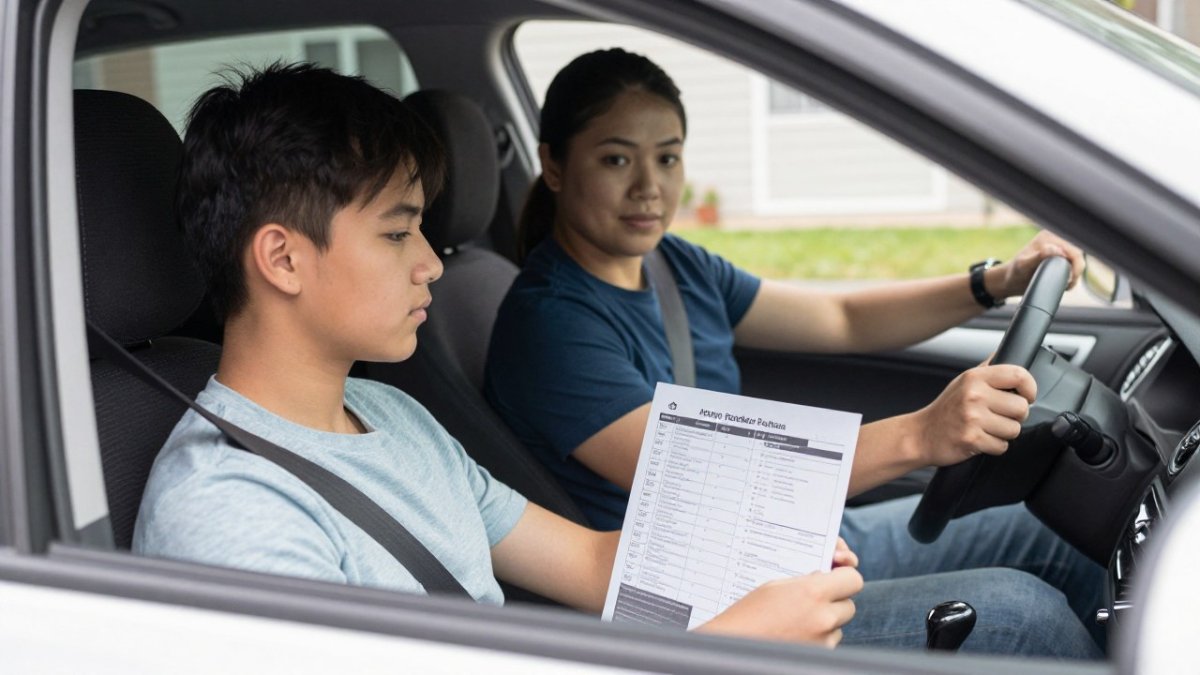
Structure your sessions so each one has a goal. A simple plan works well:
- Early sessions: Empty parking lots, starting, stopping and steering
- Middle sessions: Quiet neighborhood streets and basic turns
- Later sessions: Traffic, highways and changing weather
Keep early drives short and stop while everyone is still calm.
Managing Driving Anxiety in New Teen Drivers
Nervousness is common for teens behind the wheel, and it usually eases with steady, predictable practice. Parents looking for guidance can read how to teach a nervous teen driver, step by step. Some teens, though, feel anxiety that interferes with their daily life or makes driving feel unsafe.
Start with small, familiar routes and acknowledge small wins. Talk openly about what feels hard, and avoid yelling, since tension makes learning harder. Save relaxation exercises for home or for a safely parked car. A driver should never try breathing or grounding exercises while the car is moving.
If anxiety keeps a teen from driving or affects sleep, school, or family life, talk with a doctor or licensed health professional. A professional driving instructor can also help with confidence-building lessons.
Your Next Step: Confirm Eligibility With Louisiana OMV Before Enrolling
Before you pay for a course or book a test, confirm your teen's eligibility with the Louisiana OMV. The state's official rules set the final answer, and they can change, so treat any article as a starting point.
Once you have the official age and document requirements, you can plan practice time and enrollment with confidence. You can explore guided practice tools from LearnerMiles to help plan supervised practice. Start with the free First Drive Kit at https://learnermiles.com/?page=firstdrive#first-drive-kit, and learn more about workbook membership at https://learnermiles.com/?page=plans#plans.
Frequently Asked Questions
Can a 14-year-old take driver's ed in Louisiana?
A 14-year-old may be able to begin a driver education course in Louisiana, but enrollment rules, the age for classroom instruction and the age for behind-the-wheel instruction are set separately. Confirm the current minimum ages with the Louisiana Office of Motor Vehicles (OMV) and the course provider before signing up, because sources vary on these thresholds. Starting a course is not the same as being legally allowed to drive alone, which depends on the permit and licensing stages that follow.
What is the minimum age to obtain a Temporary Instructional Permit (TIP) in Louisiana?
A Temporary Instructional Permit (TIP) allows a minor to practice driving under supervision. The minimum age and required documents are listed by the Louisiana Office of Motor Vehicles. Check the OMV website for the current requirements and bring the original documents the agency specifies to the office. Practice with a TIP is supervised, and it does not authorize solo driving.
Do teens in Louisiana need to complete a classroom course before behind-the-wheel training?
Louisiana's graduated licensing process generally links classroom and behind-the-wheel instruction to specific steps, so the order matters. Confirm with the OMV and your chosen provider which instruction must be completed first and how many hours each component requires. Parent-supervised practice on its own does not replace a formally authorized driver education program. LearnerMiles is an independent educational guide and is not a state-approved course.
Can you drive by yourself at 15 in Louisiana?
Whether a 15-year-old can drive alone in Louisiana depends on the licensing stage they have reached under the state's graduated licensing system, not on age alone. Solo driving is generally restricted until a minor has met the permit, supervised-hour and course requirements for the next license class. Verify the current restrictions with the Louisiana Office of Motor Vehicles, since rules can change and local licensing authorities set the official terms. Driving skill and subjective confidence do not, on their own, establish legal eligibility.
